

[Mar 14, 2026] 100% Pass Guarantee for CSSBB Dumps with Actual Exam Questions
Today Updated CSSBB Exam Dumps Actual Questions
NEW QUESTION # 20
The principle disadvantage of fractional factorial experiments is that:
- A. measurements are less precise
- B. effects are confounded
- C. analysis is more difficult
- D. robustness is compromised
- E. experimental error is high
Answer: B
NEW QUESTION # 21
Which of the following methods is used to identify values that can cause invalid inferences?
- A. Plackett-Burman design
- B. Residual analysis
- C. Cause and effect analysis
- D. Variables sampling
Answer: B
Explanation:
Residual analysis is the correct method because it is specifically used to evaluate whether a statistical model is appropriate and whether certain observations may distort conclusions. In the CSSBB Analyze Phase, residuals are the differences between observed response values and model-predicted values. By studying residual plots, a Black Belt can detect unusual observations, outliers, changing variance, model misspecification, nonlinearity, and other issues that can lead to invalid inferences. This is especially important after regression, ANOVA, and designed experiments, because a model may appear significant while still violating assumptions that undermine the conclusions. Variables sampling is a data collection approach, not a diagnostic method for invalid inference. Plackett-Burman design is a screening DOE design used to identify potentially important factors, not to check model validity after analysis. Cause and effect analysis is useful for organizing possible causes of a problem, but it does not statistically identify influential data values or problematic residual behavior. Therefore, among the listed options, residual analysis is the verified CSSBB answer because it is the proper statistical tool for identifying values or patterns that can make conclusions unreliable.
NEW QUESTION # 22
Find the value of (13) in the ANOVA table. Assume:
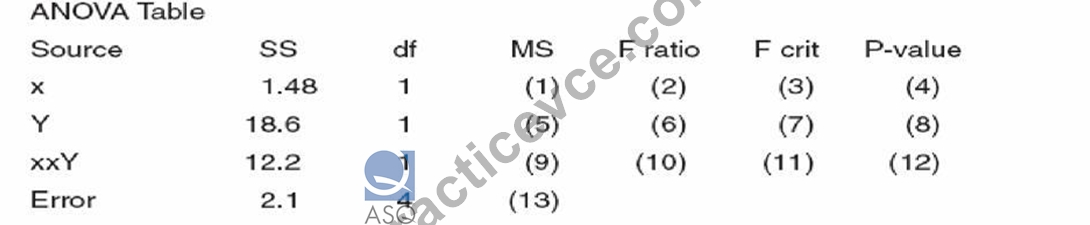
- A. 0.005<P<0.01
- B. 23.2
- C. 0.10<P<1
- D. 0.05<P<0.10
- E. 12.2
- F. 3.2
- G. 35.4
- H. 18.6
- I. 4.54
- J. 0.525
- K. 16.4
- L. 0<P<0.005
- M. 1.48
- N. 0.01<P<0.05
- O. 2.82
Answer: J
NEW QUESTION # 23
What is the most common method for displaying calibration for a gage?
- A. RFID tag
- B. Barcode
- C. Label
- D. Handwritten
Answer: C
Explanation:
The correct answer is Label. In the CSSBB metrology and measurement-system material, calibration control requires that measuring equipment be identified, controlled, calibrated, and linked to records. The text further states that a labeling system must be in place showing the identification of each piece of measuring equipment and its status. This directly supports the use of a label as the standard and most common display method for calibration status on a gage. Labels typically show the last calibration date, due date, equipment identification, and status, making them simple, visible, and practical at the point of use. While barcodes, RFID, or handwritten information can be used as supporting mechanisms in some organizations, the CSSBB framework explicitly identifies the labeling system as the required and recognized method for indicating calibration status. From a Measure Phase perspective, this matters because the integrity of the measurement system depends on ensuring that only properly calibrated equipment is used. Clear labeling prevents the accidental use of nonconforming or overdue gages and supports traceability, audit readiness, and confidence in collected data.
NEW QUESTION # 24
Common and ______________ Cause Variation are the focus of Statistical Process Control.
- A. Special
- B. Selective
- C. Uncommon
- D. Ordinary
Answer: A
NEW QUESTION # 25
For the data shown here which statement(s) are true? (Note: There are 2 correct answers).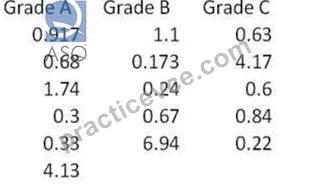
- A. If we wanted to compare the Central Tendencies of all three samples we could use the Mann- Whitney test
- B. If we wanted to compare the Central Tendencies of these three samples we would use the one way ANOVA test
- C. With 95% confidence, we cannot conclude if the samples are from three Normal Distributions
- D. If we wanted to compare the Central Tendencies of these three samples we could use Mood's Median test
- E. With greater than 95% confidence, we conclude the samples are from Non-normal Distributions
Answer: D,E
NEW QUESTION # 26
Assessing process proportion as opposed to evaluating a process with respect to a set target can be done using which of these?
- A. Proportion of the tail is equal
- B. Target is current
- C. Process proportion equals some desired value
- D. Process proportion equals some value range
Answer: C
NEW QUESTION # 27
An important step in determining the VOC is:
- A. all of the above
- B. establish viable or comprehensive process feedback loops
- C. ascertain the principles that are values of the corporation
- D. none of the above
- E. measure the virtual operating continuum potential
- F. identify the customer
Answer: F
NEW QUESTION # 28
A helpful time to use a Quality Function Deployment matrix is:
- A. while planning for a new or redesigned product
- B. all of the above
- C. while planning for new or redesigned parts
- D. none of the above
- E. while planning for a new or redesigned process
Answer: B
NEW QUESTION # 29
Nominal Group Technique is used to:
- A. generate a group on new ideas
- B. provide a name for the group
- C. provide a consistent stable group leadership
- D. help a group reach consensus
Answer: D
NEW QUESTION # 30
What conclusion is most correct about the Experimental Design shown here with the response in the far right column?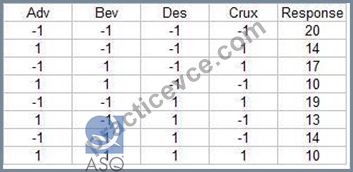
- A. If the Adv is increased from the low level to the high level, the response rate increases
- B. Constant, Adv and Bev are the only factors statistically affecting the response rate with 95% confidence or more
- C. The response level is statistically concluded to only need the Adv and Bev factors set at the low level to get the largest response rate
- D. No factor has enough statistical confidence greater than 95% to have an impact on the response rate
- E. This design does not have enough experimental runs to conclude anything as evidenced by the lack of P-values in the MINITABTM output
Answer: C
NEW QUESTION # 31
When we compare short-term and long-term Capability which of these is true?
- A. Cp is better for the short term
- B. Performance tends to improve over time
- C. Cp is better for the long-term
- D. Both short-term and long-term performance are alike
Answer: A
NEW QUESTION # 32
Which item(s) listed would impact the Process Capability for a process with a continuous output? (Note: There are 4 correct answers).
- A. Seasonal variation in process
- B. Shape of process data distribution (e.g. Normal Distribution)
- C. Presence of Special Causes or solely Common Causes
- D. Process Technology
- E. Process Standard Deviation
Answer: A,B,C,E
NEW QUESTION # 33
Which value of x will minimize transmitted noise?
- A. X3
- B. X4
- C. X1
- D. X2
Answer: A
NEW QUESTION # 34
How many experimental runs exist in a Full Factorial and fully randomized design for 4 factors with 2 replicates for the Corner Points and no Center Points? The factors in the experiment are only at 2-levels.
- A. 0
- B. 1
- C. 2
- D. 3
Answer: A
NEW QUESTION # 35
......
CSSBB exam dumps with real ASQ questions and answers: https://vce4exams.practicevce.com/ASQ/CSSBB-practice-exam-dumps.html