

Free IBM C1000-130 Test Practice Test Questions Exam Dumps
Prepare Top IBM C1000-130 Exam Audio Study Guide Practice Questions Edition
NEW QUESTION # 16
Given the high availability requirements for a Cloud Pak for Integration deployment, which two components require a quorum for high availability?
- A. API Management (API Connect)
- B. Application Integration (App Connect)
- C. Event Gateway Service
- D. Multi-instance Queue Manager
- E. Automation Assets
Answer: A,D
Explanation:
In IBM Cloud Pak for Integration (CP4I) v2021.2, ensuring high availability (HA) requires certain components to maintain a quorum. A quorum is a mechanism where a majority of nodes or instances must agree on a state to prevent split-brain scenarios and ensure consistency.
Why "Multi-instance Queue Manager" (A) Requires a Quorum?
IBM MQ Multi-instance Queue Manager is designed for high availability.
It runs in an active-standby configuration where a shared storage is required, and a quorum ensures that failover occurs correctly.
If the primary queue manager fails, quorum logic ensures that another instance assumes control without data corruption.
Why "API Management (API Connect)" (B) Requires a Quorum?
API Connect operates in a distributed cluster architecture where multiple components (such as the API Manager, Analytics, and Gateway) work together.
A quorum is required to ensure consistency and avoid conflicts in API configurations across multiple instances.
API Connect uses MongoDB as its backend database, and MongoDB requires a replica set quorum for high availability and failover.
Why Not the Other Options?
Option
Reason for Exclusion
C . Application Integration (App Connect)
While App Connect can be deployed in HA mode, it does not require a quorum. It uses Kubernetes scaling and load balancing instead.
D . Event Gateway Service
Event Gateway is stateless and relies on horizontal scaling rather than quorum-based HA.
E . Automation Assets
This component stores automation-related assets but does not require quorum for HA. It typically relies on persistent storage replication.
Thus, Multi-instance Queue Manager (IBM MQ) and API Management (API Connect) require quorum to ensure high availability in Cloud Pak for Integration.
IBM Cloud Pak for Integration (CP4I) v2021.2 Administration Reference:
IBM MQ Multi-instance Queue Manager HA
IBM API Connect High Availability and Quorum
CP4I High Availability Architecture
MongoDB Replica Set Quorum in API Connect
NEW QUESTION # 17
An administrator is looking to install Cloud Pak for Integration on an OpenShift cluster. What is the result of executing the following?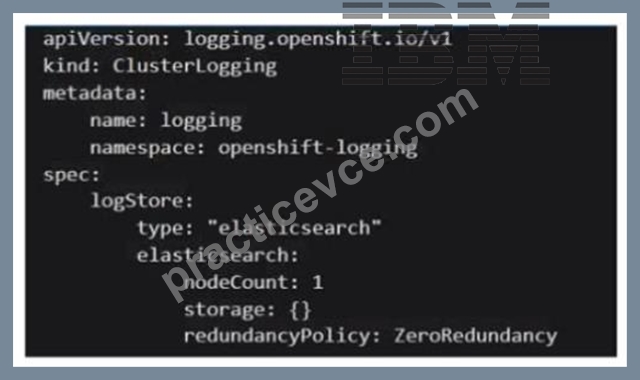
- A. A single node ElasticSearch cluster with default persistent storage.
- B. A single node ElasticSearch cluster with no persistent storage.
- C. A single node ElasticSearch cluster which auto scales when redundancyPolicy is set to MultiRedundancy.
- D. A single infrastructure node with persisted ElasticSearch.
Answer: B
Explanation:
The given YAML configuration is for ClusterLogging in an OpenShift environment, which is used for centralized logging. The key part of the specification that determines the behavior of Elasticsearch is:
logStore:
type: "elasticsearch"
elasticsearch:
nodeCount: 1
storage: {}
redundancyPolicy: ZeroRedundancy
Analysis of Key Fields:
nodeCount: 1
This means the Elasticsearch cluster will consist of only one node (single-node deployment).
storage: {}
The empty storage field implies no persistent storage is configured.
This means that if the pod is deleted or restarted, all stored logs will be lost.
redundancyPolicy: ZeroRedundancy
ZeroRedundancy means there is no data replication, making the system vulnerable to data loss if the pod crashes.
In contrast, a redundancy policy like MultiRedundancy ensures high availability by replicating data across multiple nodes, but that is not the case here.
Evaluating Answer Choices:
Option
Explanation:
Correct?
A . A single node ElasticSearch cluster with default persistent storage.
Incorrect, because storage: {} means no persistent storage is configured.
❌
B . A single infrastructure node with persisted ElasticSearch.
Incorrect, as this is not configuring an infrastructure node, and storage is not persistent.
❌
C . A single node ElasticSearch cluster which auto scales when redundancyPolicy is set to MultiRedundancy.
Incorrect, because setting MultiRedundancy does not automatically enable auto-scaling. Scaling needs manual intervention or Horizontal Pod Autoscaler (HPA).
❌
D . A single node ElasticSearch cluster with no persistent storage.
Correct, because nodeCount: 1 creates a single node, and storage: {} ensures no persistent storage.
✅
Final answer:
✅ D. A single node ElasticSearch cluster with no persistent storage.
IBM Cloud Pak for Integration (CP4I) v2021.2 Administration Reference:
IBM CP4I Logging and Monitoring Documentation
Red Hat OpenShift Logging Documentation
Elasticsearch Redundancy Policies in OpenShift Logging
NEW QUESTION # 18
What is the default time period for the data retrieved by the License Service?
- A. The full period from the deployment.
- B. 60 days.
- C. 90 days.
- D. 30 days.
Answer: D
Explanation:
Explanation
https://www.ibm.com/docs/SSHKN6/license-service/1.x.x/APIs.html
NEW QUESTION # 19
An administrator is looking to install Cloud Pak for Integration on an OpenShift cluster. What is the result of executing the following?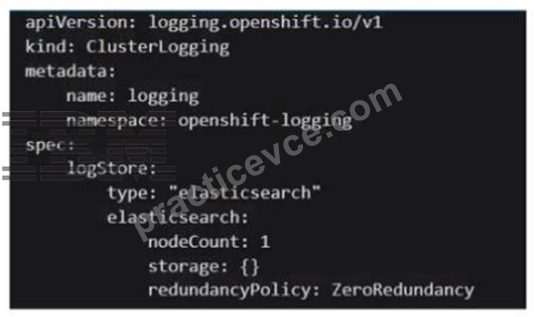
- A. A single node ElasticSearch cluster with default persistent storage.
- B. A single node ElasticSearch cluster with no persistent storage.
- C. A single node ElasticSearch cluster which auto scales when redundancyPolicy is set to MultiRedundancy.
- D. A single infrastructure node with persisted ElasticSearch.
Answer: B
NEW QUESTION # 20
What is one way to obtain the OAuth secret and register a workload to Identity and Access Management?
- A. Using the OperandConfig API file
- B. Through the Red Hat Marketplace.
- C. Using a Custom Resource Definition (CRD) file.
- D. Extracting the ibm-entitlement-key secret.
Answer: C
NEW QUESTION # 21
Select all that apply
What is the correct order of the Operations Dashboard upgrade?
Answer:
Explanation: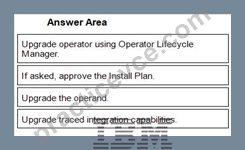
1 - Upgrade operator using Operator Lifecycle Manager.
2 - If asked, approve the Install Plan.
3 - Upgrade the operand.
4 - Upgrade traced integration capabilities.
NEW QUESTION # 22
What is a prerequisite when configuring foundational services IAM for single-sign-on?
- A. Access to IBM Cloud Pak for Integration as kubeadmin.
- B. Access to OpenShift cluster as root.
- C. Access to the OpenShift Container Platform console as kubeadmin.
- D. Access to IAM service as administrator.
Answer: C
Explanation:
Foundational Services deployment was first created with a large profile.
NEW QUESTION # 23
What are the two custom resources provided by IBM Licensing Operator?
- A. IBM License Collector
- B. IBM License Reporting
- C. IBM License Viewer
- D. IBM License Service
- E. IBM License Service Reporter
Answer: A,D
Explanation:
The IBM Licensing Operator is responsible for managing and tracking IBM software license consumption in OpenShift and Kubernetes environments. It provides two key Custom Resources (CRs) to facilitate license tracking, reporting, and compliance in IBM Cloud Pak deployments:
IBM License Collector (IBMLicenseCollector)
This custom resource is responsible for collecting license usage data from IBM Cloud Pak components and aggregating the data for reporting.
It gathers information from various IBM products deployed within the cluster, ensuring that license consumption is tracked accurately.
IBM License Service (IBMLicenseService)
This custom resource provides real-time license tracking and metering for IBM software running in a containerized environment.
It is the core service that allows administrators to query and verify license usage.
The IBM License Service ensures compliance with IBM Cloud Pak licensing requirements and integrates with the IBM License Service Reporter for extended reporting capabilities.
Why the other options are incorrect:
B . IBM License Service Reporter - Incorrect
While IBM License Service Reporter exists as an additional reporting tool, it is not a custom resource provided directly by the IBM Licensing Operator. Instead, it is a component that enhances license reporting outside the cluster.
C . IBM License Viewer - Incorrect
No such CR exists. IBM License information can be viewed through OpenShift or CLI, but there is no "License Viewer" CR.
E . IBM License Reporting - Incorrect
While reporting is a function of IBM License Service, there is no custom resource named "IBM License Reporting." IBM Cloud Pak for Integration (CP4I) v2021.2 Administration Reference:
IBM Licensing Service Documentation
IBM Cloud Pak Licensing Overview
OpenShift and IBM License Service Integration
NEW QUESTION # 24
An administrator is installing Cloud Pak for Integration onto an OpenShift cluster that does not have access to the internet.
How do they provide their ibm-entitlement-key when mirroring images to a portable registry?
- A. The ibm-entitlement-key is added as a docker-registry secret onto the OpenShift cluster.
- B. The administrator uses a cloudctl case command to configure credentials for registries which require authentication before mirroring the images.
- C. The administrator adds the entitlement-key to the properties file SHOME/.airgap/registries on the Bastion Host.
- D. The administrator sets the key with "export ENTITLEMENTKEY" and then uses the "cloudPakOfflmelnstaller -mirror-images" script to mirror the images
Answer: D
NEW QUESTION # 25
Which statement is true about the Authentication URL user registry in API Connect?
- A. It authenticates users by referencing a custom identity provider.
- B. It authenticates Cloud Manager users.
- C. It authenticates Developer Portal sites.
- D. It authenticates users defined in a provider organization.
Answer: A
Explanation:
In IBM API Connect, an Authentication URL user registry is a type of user registry that allows authentication by delegating user verification to an external identity provider. This is typically used when API Connect needs to integrate with custom authentication mechanisms, such as OAuth, OpenID Connect, or SAML-based identity providers.
When configured, API Connect does not store user credentials locally. Instead, it redirects authentication requests to the specified external authentication URL, and if the response is valid, the user is authenticated.
Why Answer D is Correct:
The Authentication URL user registry is specifically designed to reference an external custom identity provider.
This enables API Connect to integrate with external authentication systems like LDAP, Active Directory, OAuth, and OpenID Connect.
It is commonly used for single sign-on (SSO) and enterprise authentication strategies.
Explanation of Incorrect Answers:
A . It authenticates Developer Portal sites. → Incorrect
The Developer Portal uses its own authentication mechanisms, such as LDAP, local user registries, and external identity providers, but the Authentication URL user registry does not authenticate Developer Portal users directly.
B . It authenticates users defined in a provider organization. → Incorrect Users in a provider organization (such as API providers and administrators) are typically authenticated using Cloud Manager or an LDAP-based user registry, not via an Authentication URL user registry.
C . It authenticates Cloud Manager users. → Incorrect
Cloud Manager users are typically authenticated via LDAP or API Connect's built-in user registry.
The Authentication URL user registry is not responsible for Cloud Manager authentication.
IBM Cloud Pak for Integration (CP4I) v2021.2 Administration Reference:
IBM API Connect User Registry Types
IBM API Connect Authentication and User Management
IBM Cloud Pak for Integration Documentation
https://www.ibm.com/docs/SSMNED_v10/com.ibm.apic.cmc.doc/capic_cmc_registries_concepts.html
NEW QUESTION # 26
An administrator has configured OpenShift Container Platform (OCP) log forwarding to external third-party systems. What is expected behavior when the external logging aggregator becomes unavailable and the collected logs buffer size has been completely filled?
- A. OCP store the logs in a temporary PVC.
- B. OCP rotates the logs and deletes them.
- C. OCP extends the buffer size and resumes logs collection.
- D. The Fluentd daemon is forced to stop.
Answer: C
NEW QUESTION # 27
An administrator is checking that all components and software in their estate are licensed. They have only purchased Cloud Pak for Integration (CP41) li-censes.
How are the OpenShift master nodes licensed?
- A. CP41 licenses include entitlement for 3 cores of OpenShift per core of CP41.
- B. The administrator will need to purchase additional OpenShift licenses to cover the master nodes.
- C. CP41 licenses include entitlement for the entire OpenShift cluster that they run on, and the administrator can count against the master nodes.
- D. OpenShift master nodes do not consume OpenShift license entitlement, so no license is needed.
Answer: D
Explanation:
In IBM Cloud Pak for Integration (CP4I) v2021.2, licensing is based on Virtual Processor Cores (VPCs), and it includes entitlement for OpenShift usage. However, OpenShift master nodes (control plane nodes) do not consume license entitlement, because:
OpenShift licensing only applies to worker nodes.
The master nodes (control plane nodes) manage cluster operations and scheduling, but they do not run user workloads.
IBM's Cloud Pak licensing model considers only the worker nodes for licensing purposes.
Master nodes are essential infrastructure and are excluded from entitlement calculations.
IBM and Red Hat do not charge for OpenShift master nodes in Cloud Pak deployments.
Explanation of Incorrect Answers:
A . CP4I licenses include entitlement for the entire OpenShift cluster that they run on, and the administrator can count against the master nodes. → ❌ Incorrect CP4I licenses do cover OpenShift, but only for worker nodes where workloads are deployed.
Master nodes are excluded from licensing calculations.
C . The administrator will need to purchase additional OpenShift licenses to cover the master nodes. → ❌ Incorrect No additional OpenShift licenses are required for master nodes.
OpenShift licensing only applies to worker nodes that run applications.
D . CP4I licenses include entitlement for 3 cores of OpenShift per core of CP4I. → ❌ Incorrect The standard IBM Cloud Pak licensing model provides 1 VPC of OpenShift for 1 VPC of CP4I, not a 3:1 ratio.
Additionally, this applies only to worker nodes, not master nodes.
IBM Cloud Pak for Integration (CP4I) v2021.2 Administration Reference:
IBM Cloud Pak Licensing Guide
IBM Cloud Pak for Integration Licensing Details
Red Hat OpenShift Licensing Guide
NEW QUESTION # 28
Which statement is true for BAR files storage?
- A. The storage type cannot be changed after Dashboard is created.
- B. The BAR files must be stored in a volume in the container's file system.
- C. Persistent-claim storage is required.
- D. The storage type can be changed after the Dashboard is created.
Answer: D
Explanation:
Explanation
https://www.ibm.com/docs/en/app-connect/containers_cd?topic=resources-dashboard-reference
NEW QUESTION # 29
What is the outcome when the API Connect operator is installed at the cluster scope?
- A. The operator installs in a production deployment profile.
- B. Automatic updates will be restricted by the approval strategy.
- C. The entire cluster effectively behaves as one large tenant.
- D. API Connect services will be deployed in the default namespace.
Answer: A
NEW QUESTION # 30
What type of storage is required by the API Connect Management subsystem?
- A. RWX block storage
- B. NFS
- C. GlusterFS
- D. RWO block storage
Answer: D
NEW QUESTION # 31
What ate two ways to add the IBM Cloud Pak tor Integration CatalogSource ob-jects to an OpenShift cluster that has access to the internet?
- A. Download the Cloud Pak for Integration driver from partnercentral.ibm.com to a local machine and deploy using the oc new-project command line option
- B. Copy the resource definition code into a file and use the oc apply -f filename command line option.
- C. Import the catalog project from https://ibm.github.eom/icr-io/cp4int:2.4
- D. Paste the resource definition code into the import YAML dialog of the OpenShift Admin web console and click Create.
- E. Deploy the catalog the Red Hat OpenShift Application Runtimes.
Answer: B,D
Explanation:
To add the IBM Cloud Pak for Integration (CP4I) CatalogSource objects to an OpenShift cluster that has internet access, there are two primary methods:
Using oc apply -f filename (Option A)
The CatalogSource resource definition can be written in a YAML file and applied using the OpenShift CLI.
This method ensures that the cluster is correctly set up with the required catalog sources for CP4I.
Example command:
sh
CopyEdit
oc apply -f cp4i-catalogsource.yaml
This is a widely used approach for configuring OpenShift resources.
Using the OpenShift Admin Web Console (Option E)
Administrators can manually paste the CatalogSource YAML definition into the OpenShift Admin Web Console.
Navigate to Administrator → Operators → OperatorHub → Create CatalogSource, paste the YAML, and click Create.
This provides a UI-based alternative to using the CLI.
Explanation of Incorrect Options:
B (Incorrect): There is no valid icr-io/cp4int:2.4 catalog project import method for adding a CatalogSource. IBM's container images are hosted on IBM Cloud Container Registry (ICR), but this method is not used for adding a CatalogSource.
C (Incorrect): Red Hat OpenShift Application Runtimes (RHOAR) is unrelated to the CatalogSource object creation for CP4I.
D (Incorrect): Downloading the CP4I driver and using oc new-project is not the correct approach for adding a CatalogSource. The oc new-project command is used to create OpenShift projects but does not deploy catalog sources.
IBM Cloud Pak for Integration (CP4I) v2021.2 Administration Reference:
IBM Documentation: Managing Operator Lifecycle with OperatorHub
OpenShift Docs: Creating a CatalogSource
IBM Knowledge Center: Installing IBM Cloud Pak for Integration
NEW QUESTION # 32
Which OpenShift component controls the placement of workloads on nodes for Cloud Pak for Integration deployments?
- A. Controller Manager
- B. Scheduler
- C. API Server
- D. Etcd
Answer: B
Explanation:
In IBM Cloud Pak for Integration (CP4I) v2021.2, which runs on Red Hat OpenShift, the component responsible for determining the placement of workloads (pods) on worker nodes is the Scheduler.
Explanation of OpenShift Components:
API Server (Option A): The API Server is the front-end of the OpenShift and Kubernetes control plane, handling REST API requests, authentication, and cluster state updates. However, it does not decide where workloads should be placed.
Controller Manager (Option B): The Controller Manager ensures the desired state of the system by managing controllers (e.g., ReplicationController, NodeController). It does not handle pod placement.
Etcd (Option C): Etcd is the distributed key-value store used by OpenShift and Kubernetes to store cluster state data. It plays no role in scheduling workloads.
Scheduler (Option D - Correct Answer): The Scheduler is responsible for selecting the most suitable node to run a newly created pod based on resource availability, affinity/anti-affinity rules, and other constraints.
Why the Scheduler is Correct?
When a new pod is created, it initially has no assigned node.
The Scheduler evaluates all worker nodes and assigns the pod to the most appropriate node, ensuring balanced resource utilization and policy compliance.
In CP4I, efficient workload placement is crucial for maintaining performance and resilience, and the Scheduler ensures that workloads are optimally distributed across the cluster.
IBM Cloud Pak for Integration (CP4I) v2021.2 Administration Reference:
IBM CP4I Documentation - Deploying on OpenShift
Red Hat OpenShift Documentation - Understanding the Scheduler
Kubernetes Documentation - Scheduler
NEW QUESTION # 33
What authentication information is provided through Base DN in the LDAP configuration process?
- A. Distinguished name of the search base.
- B. Configuration file path.
- C. Name of the database.
- D. Path to the server containing the Directory.
Answer: D
NEW QUESTION # 34
What automates permissions-based workload isolation in Foundational Services?
- A. Node taints and pod tolerations.
- B. The IAM operator.
- C. The NamespaceScope operator.
- D. The Operand Deployment Lifecycle Manager.
Answer: A
NEW QUESTION # 35
What is the result Of issuing the oc extract secret/platform-auth-idp-credentials --to=- command?
- A. Generates Base64 decoded secrets for all Cloud Pak for Integration users.
- B. Distributes credentials throughout the Cloud Pak for Integration platform.
- C. Displays the credentials of the admin user.
- D. Writes the OpenShift Container Platform credentials to the current directory.
Answer: C
Explanation:
The command:
oc extract secret/platform-auth-idp-credentials --to=-
is used to retrieve and display the admin user credentials stored in the platform-auth-idp-credentials secret within an OpenShift-based IBM Cloud Pak for Integration (CP4I) deployment.
Why Option C (Displays the credentials of the admin user) is Correct:
In IBM Cloud Pak Foundational Services, the platform-auth-idp-credentials secret contains the admin username and password used to authenticate with OpenShift and Cloud Pak services.
The oc extract command decodes the secret and displays its contents in plaintext in the terminal.
The --to=- flag directs the output to standard output (STDOUT), ensuring that the credentials are immediately visible instead of being written to a file.
This command is commonly used for recovering lost admin credentials or retrieving them for automated processes.
Explanation of Incorrect Answers:
A . Writes the OpenShift Container Platform credentials to the current directory. → Incorrect The --to=- option displays the credentials, but it does not write them to a file in the directory.
To save the credentials to a file, the command would need a filename, e.g., --to=admin-creds.txt.
B . Generates Base64 decoded secrets for all Cloud Pak for Integration users. → Incorrect The command only extracts one specific secret (platform-auth-idp-credentials), which contains the admin credentials only.
It does not generate or decode secrets for all users.
D . Distributes credentials throughout the Cloud Pak for Integration platform. → Incorrect The command extracts and displays credentials, but it does not distribute or propagate them.
Credentials distribution in Cloud Pak for Integration is handled through Identity and Access Management (IAM) configurations.
IBM Cloud Pak for Integration (CP4I) v2021.2 Administration Reference:
IBM Cloud Pak Foundational Services - Retrieving Admin Credentials
OpenShift CLI (oc extract) Documentation
IBM Cloud Pak for Integration Identity and Access Management
NEW QUESTION # 36
Which statement is true about App Connect Designer?
- A. For each App Connect Designer instance, a corresponding toolkit instance must be created.
- B. Only one instance of App Connect Designer can be created in a namespace.
- C. App Connect Designer must be linked to a toolkit for validation.
- D. Multiple instances of App Connect Designer can be created in a namespace.
Answer: D
NEW QUESTION # 37
An administrator has to implement high availability for various components of a Cloud Pak for Integration installation. Which two statements are true about the options available?
- A. Platform Navigator uses an Active/Active deployment, where the primary handles all the traffic and in case of failure of the primary, the load balancer will then route the traffic to the secondary.
- B. AppConnect can use a mix of mechanisms - like failover for stateful workloads and active/active deployments for stateless workloads
- C. Queue Manager (MQ) uses Replicated Data Queue Manager (RDQM).
- D. DataPower gateway uses a Quorum mechanism where a global load balancer uses quorum algorithm to choose the active instance.
- E. API management uses a quorum mechanism where components are deployed on a minimum of three failure domains.
Answer: C,E
Explanation:
High availability (HA) in IBM Cloud Pak for Integration (CP4I) v2021.2 is crucial to ensure continuous service availability and reliability. Different components use different HA mechanisms, and the correct options are B and C.
Correct Answers Explanation:
B . Queue Manager (MQ) uses Replicated Data Queue Manager (RDQM).
IBM MQ supports HA through Replicated Data Queue Manager (RDQM), which uses synchronous data replication across nodes.
This ensures failover to another node without data loss if the primary node goes down.
RDQM is an efficient HA solution for MQ in CP4I.
C . API management uses a quorum mechanism where components are deployed on a minimum of three failure domains.
API Connect in CP4I follows a quorum-based HA model, meaning that the deployment is designed to function across at least three failure domains (availability zones).
This ensures resilience and prevents split-brain scenarios in case of node failures.
Incorrect Answers Explanation:
A . DataPower gateway uses a Quorum mechanism where a global load balancer uses a quorum algorithm to choose the active instance. → Incorrect DataPower typically operates in Active/Standby mode rather than a quorum-based model.
It can be deployed behind a global load balancer, but the quorum algorithm is not used to determine the active instance.
D . Platform Navigator uses an Active/Active deployment, where the primary handles all the traffic and in case of failure of the primary, the load balancer will then route the traffic to the secondary. → Incorrect Platform Navigator does not follow a traditional Active/Active deployment.
It is typically deployed as a highly available microservice on OpenShift, distributing workloads across nodes.
E . AppConnect can use a mix of mechanisms - like failover for stateful workloads and active/active deployments for stateless workloads. → Incorrect While AppConnect can be deployed in Active/Active mode, it does not necessarily mix failover and active/active mechanisms explicitly for HA purposes.
IBM Cloud Pak for Integration (CP4I) v2021.2 Administration Reference:
IBM MQ High Availability and RDQM
IBM API Connect High Availability
IBM DataPower Gateway HA Deployment
IBM Cloud Pak for Integration Documentation
NEW QUESTION # 38
The OpenShift Logging Operator monitors a particular Custom Resource (CR). What is the name of the Custom Resource used by the OpenShift Logging Opera-tor?
- A. LoggingResource
- B. ElasticsearchLog
- C. DefaultLogging
- D. ClusterLogging
Answer: D
NEW QUESTION # 39
Which publicly available document lists known Cloud Pak for Integration problems and limitations?
- A. IBM Cloud Pak for Integration - Q&A
- B. IBM Cloud Pak for Integration - Known Problems
- C. IBM Cloud Pak for Integration - Known Limitations
- D. IBM Cloud Pak for Integration - Latest News
Answer: C
Explanation:
IBM provides a publicly available document that lists the known issues, limitations, and restrictions for each release of IBM Cloud Pak for Integration (CP4I). This document is called "IBM Cloud Pak for Integration - Known Limitations." It details any functional restrictions, unresolved issues, and workarounds applicable to the current and previous versions of CP4I.
This document helps administrators and developers understand current limitations before deploying or upgrading CP4I components.
It is updated regularly as IBM identifies new issues or resolves existing ones.
Analysis of Incorrect Options:
A . IBM Cloud Pak for Integration - Q&A (Incorrect)
A Q&A section typically contains frequently asked questions (FAQs) but does not specifically focus on known issues or limitations.
C . IBM Cloud Pak for Integration - Known Problems (Incorrect)
IBM does not maintain a document explicitly titled "Known Problems." Instead, known issues are included under "Known Limitations." D . IBM Cloud Pak for Integration - Latest News (Incorrect) The "Latest News" section typically covers new features, updates, and release announcements, but it does not provide a dedicated list of limitations or unresolved issues.
IBM Cloud Pak for Integration (CP4I) v2021.2 Administration Reference:
IBM Cloud Pak for Integration - Known Limitations
IBM Cloud Pak for Integration Documentation
IBM Support - Fixes and Known Issues
NEW QUESTION # 40
......
IBM C1000-130 (IBM Cloud Pak for Integration V2021.2 Administration) Certification Exam is an essential certification for professionals who want to demonstrate their expertise in administering IBM Cloud Pak for Integration V2021.2. IBM Cloud Pak for Integration V2021.2 Administration certification can help professionals advance their careers and open up new job opportunities in the field of integration and cloud computing.
Go to C1000-130 Questions - Try C1000-130 dumps pdf: https://vce4exams.practicevce.com/IBM/C1000-130-practice-exam-dumps.html