

[2024] Databricks-Certified-Data-Analyst-Associate Exam Dumps, Test Engine Practice Test Questions
Pass Databricks-Certified-Data-Analyst-Associate exam [Apr 19, 2024] Updated 47 Questions
NEW QUESTION # 10
A data analyst has set up a SQL query to run every four hours on a SQL endpoint, but the SQL endpoint is taking too long to start up with each run.
Which of the following changes can the data analyst make to reduce the start-up time for the endpoint while managing costs?
- A. Use a Serverless SQL endpoint
- B. Increase the SQL endpoint cluster size
- C. Reduce the SQL endpoint cluster size
- D. Turn off the Auto stop feature
- E. Increase the minimum scaling value
Answer: A
Explanation:
A Serverless SQL endpoint is a type of SQL endpoint that does not require a dedicated cluster to run queries. Instead, it uses a shared pool of resources that can scale up and down automatically based on the demand. This means that a Serverless SQL endpoint can start up much faster than a SQL endpoint that uses a cluster, and it can also save costs by only paying for the resources that are used. A Serverless SQL endpoint is suitable for ad-hoc queries and exploratory analysis, but it may not offer the same level of performance and isolation as a SQL endpoint that uses a cluster. Therefore, a data analyst should consider the trade-offs between speed, cost, and quality when choosing between a Serverless SQL endpoint and a SQL endpoint that uses a cluster. Reference: Databricks SQL endpoints, Serverless SQL endpoints, SQL endpoint clusters
NEW QUESTION # 11
Which of the following layers of the medallion architecture is most commonly used by data analysts?
- A. Silver
- B. None of these layers are used by data analysts
- C. All of these layers are used equally by data analysts
- D. Gold
- E. Bronze
Answer: D
Explanation:
The gold layer of the medallion architecture contains data that is highly refined and aggregated, and powers analytics, machine learning, and production applications. Data analysts typically use the gold layer to access data that has been transformed into knowledge, rather than just information. The gold layer represents the final stage of data quality and optimization in the lakehouse. Reference: What is the medallion lakehouse architecture?
NEW QUESTION # 12
A data analyst is processing a complex aggregation on a table with zero null values and their query returns the following result:
Which of the following queries did the analyst run to obtain the above result?
- A.

- B.

- C.

- D.

- E.

Answer: D
Explanation:
The result set provided shows a combination of grouping by two columns (group_1 and group_2) with subtotals for each level of grouping and a grand total. This pattern is typical of a GROUP BY ... WITH ROLLUP operation in SQL, which provides subtotal rows and a grand total row in the result set.
Considering the query options:
A) Option A: GROUP BY group_1, group_2 INCLUDING NULL - This is not a standard SQL clause and would not result in subtotals and a grand total.
B) Option B: GROUP BY group_1, group_2 WITH ROLLUP - This would create subtotals for each unique group_1, each combination of group_1 and group_2, and a grand total, which matches the result set provided.
C) Option C: GROUP BY group_1, group 2 - This is a simple GROUP BY and would not include subtotals or a grand total.
D) Option D: GROUP BY group_1, group_2, (group_1, group_2) - This syntax is not standard and would likely result in an error or be interpreted as a simple GROUP BY, not providing the subtotals and grand total.
E) Option E: GROUP BY group_1, group_2 WITH CUBE - The WITH CUBE operation produces subtotals for all combinations of the selected columns and a grand total, which is more than what is shown in the result set.
The correct answer is Option B, which uses WITH ROLLUP to generate the subtotals for each level of grouping as well as a grand total. This matches the result set where we have subtotals for each group_1, each combination of group_1 and group_2, and the grand total where both group_1 and group_2 are NULL.
NEW QUESTION # 13
Which of the following is a benefit of Databricks SQL using ANSI SQL as its standard SQL dialect?
- A. It is more performant than other SQL dialects
- B. It has increased customization capabilities
- C. It is easy to migrate existing SQL queries to Databricks SQL
- D. It allows for the use of Photon's computation optimizations
- E. It is more compatible with Spark's interpreters
Answer: C
Explanation:
Databricks SQL uses ANSI SQL as its standard SQL dialect, which means it follows the SQL specifications defined by the American National Standards Institute (ANSI). This makes it easier to migrate existing SQL queries from other data warehouses or platforms that also use ANSI SQL or a similar dialect, such as PostgreSQL, Oracle, or Teradata. By using ANSI SQL, Databricks SQL avoids surprises in behavior or unfamiliar syntax that may arise from using a non-standard SQL dialect, such as Spark SQL or Hive SQL12. Moreover, Databricks SQL also adds compatibility features to support common SQL constructs that are widely used in other data warehouses, such as QUALIFY, FILTER, and user-defined functions2. Reference: ANSI compliance in Databricks Runtime, Evolution of the SQL language at Databricks: ANSI standard by default and easier migrations from data warehouses
NEW QUESTION # 14
A data analyst has been asked to use the below table sales_table to get the percentage rank of products within region by the sales:
The result of the query should look like this:
Which of the following queries will accomplish this task?
A)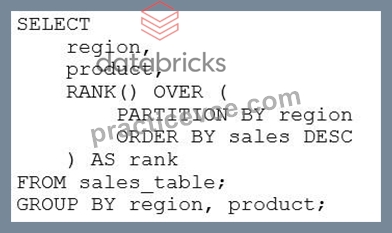
B)
C)

- A. Option C
- B. Option D
- C. Option B
- D. Option A
Answer: C
Explanation:
The correct query to get the percentage rank of products within region by the sales is option B. This query uses the PERCENT_RANK() window function to calculate the relative rank of each product within each region based on the sales amount. The window function is partitioned by region and ordered by sales in descending order. The result is aliased as rank and displayed along with the region and product columns. The other options are incorrect because:
A) Option A uses the RANK() window function instead of the PERCENT_RANK() function. The RANK() function returns the rank of each row within the partition, but not the percentage rank. Also, the query does not have a GROUP BY clause, which is required for aggregate functions like SUM().
C) Option C uses the DENSE_RANK() window function instead of the PERCENT_RANK() function. The DENSE_RANK() function returns the rank of each row within the partition, but not the percentage rank. Also, the query does not have a GROUP BY clause, which is required for aggregate functions like SUM().
D) Option D uses the ROW_NUMBER() window function instead of the PERCENT_RANK() function. The ROW_NUMBER() function returns the sequential number of each row within the partition, but not the percentage rank. Also, the query does not have a GROUP BY clause, which is required for aggregate functions like SUM(). Reference:
1: PERCENT_RANK (Transact-SQL)
2: Window functions in Databricks SQL
3: Databricks Certified Data Analyst Associate Exam Guide
NEW QUESTION # 15
A data team has been given a series of projects by a consultant that need to be implemented in the Databricks Lakehouse Platform.
Which of the following projects should be completed in Databricks SQL?
- A. Combining two data sources into a single, comprehensive dataset
- B. Automating complex notebook-based workflows with multiple tasks
- C. Testing the quality of data as it is imported from a source
- D. Tracking usage of feature variables for machine learning projects
- E. Segmenting customers into like groups using a clustering algorithm
Answer: A
Explanation:
Databricks SQL is a service that allows users to query data in the lakehouse using SQL and create visualizations and dashboards1. One of the common use cases for Databricks SQL is to combine data from different sources and formats into a single, comprehensive dataset that can be used for further analysis or reporting2. For example, a data analyst can use Databricks SQL to join data from a CSV file and a Parquet file, or from a Delta table and a JDBC table, and create a new table or view that contains the combined data3. This can help simplify the data management and governance, as well as improve the data quality and consistency. Reference:
Databricks SQL overview
Databricks SQL use cases
Joining data sources
NEW QUESTION # 16
A data analyst has recently joined a new team that uses Databricks SQL, but the analyst has never used Databricks before. The analyst wants to know where in Databricks SQL they can write and execute SQL queries.
On which of the following pages can the analyst write and execute SQL queries?
- A. Data page
- B. Dashboards page
- C. Queries page
- D. SQL Editor page
- E. Alerts page
Answer: D
Explanation:
The SQL Editor page is where the analyst can write and execute SQL queries in Databricks SQL. The SQL Editor page has a query pane where the analyst can type or paste SQL statements, and a results pane where the analyst can view the query results in a table or a chart. The analyst can also browse data objects, edit multiple queries, execute a single query or multiple queries, terminate a query, save a query, download a query result, and more from the SQL Editor page. Reference: Create a query in SQL editor
NEW QUESTION # 17
A data engineering team has created a Structured Streaming pipeline that processes data in micro-batches and populates gold-level tables. The microbatches are triggered every minute.
A data analyst has created a dashboard based on this gold-level data. The project stakeholders want to see the results in the dashboard updated within one minute or less of new data becoming available within the gold-level tables.
Which of the following cautions should the data analyst share prior to setting up the dashboard to complete this task?
- A. The required compute resources could be costly
- B. The gold-level tables are not appropriately clean for business reporting
- C. The streaming data is not an appropriate data source for a dashboard
- D. The dashboard cannot be refreshed that quickly
- E. The streaming cluster is not fault tolerant
Answer: A
Explanation:
A Structured Streaming pipeline that processes data in micro-batches and populates gold-level tables every minute requires a high level of compute resources to handle the frequent data ingestion, processing, and writing. This could result in a significant cost for the organization, especially if the data volume and velocity are large. Therefore, the data analyst should share this caution with the project stakeholders before setting up the dashboard and evaluate the trade-offs between the desired refresh rate and the available budget. The other options are not valid cautions because:
B) The gold-level tables are assumed to be appropriately clean for business reporting, as they are the final output of the data engineering pipeline. If the data quality is not satisfactory, the issue should be addressed at the source or silver level, not at the gold level.
C) The streaming data is an appropriate data source for a dashboard, as it can provide near real-time insights and analytics for the business users. Structured Streaming supports various sources and sinks for streaming data, including Delta Lake, which can enable both batch and streaming queries on the same data.
D) The streaming cluster is fault tolerant, as Structured Streaming provides end-to-end exactly-once fault-tolerance guarantees through checkpointing and write-ahead logs. If a query fails, it can be restarted from the last checkpoint and resume processing.
E) The dashboard can be refreshed within one minute or less of new data becoming available in the gold-level tables, as Structured Streaming can trigger micro-batches as fast as possible (every few seconds) and update the results incrementally. However, this may not be necessary or optimal for the business use case, as it could cause frequent changes in the dashboard and consume more resources. Reference: Streaming on Databricks, Monitoring Structured Streaming queries on Databricks, A look at the new Structured Streaming UI in Apache Spark 3.0, Run your first Structured Streaming workload
NEW QUESTION # 18
A data analyst has been asked to count the number of customers in each region and has written the following query:
If there is a mistake in the query, which of the following describes the mistake?
- A. The query is using ORDER BY. which is not allowed in an aggregation.
- B. The query is selecting region but region should only occur in the ORDER BY clause.
- C. The query is missing a GROUP BY region clause.
- D. There are no mistakes in the query.
- E. The query is using count('). which will count all the customers in the customers table, no matter the region.
Answer: C
Explanation:
In the provided SQL query, the data analyst is trying to count the number of customers in each region. However, they made a mistake by not including the "GROUP BY" clause to group the results by region. Without this clause, the query will not return counts for each distinct region but rather an error or incorrect result. Reference: The need for a GROUP BY clause in such queries can be understood from Databricks SQL documentation: Databricks SQL.
I also noticed that you uploaded an image with your question. The image shows a snippet of an SQL query written in plain text on a white background. The query is attempting to select regions and count customers from a "customers" table and order the results by region. There's no visible syntax highlighting or any other color - it's monochromatic. The query is the same as the one in your question. I'm not sure why you included the image, but maybe you wanted to show me the exact format of your query. If so, you can also use code blocks to display formatted content such as SQL queries. For example, you can write:
SELECT region, count(*) AS number_of_customers
FROM customers
ORDER BY region;
This way, you can avoid uploading images and make your questions more clear and concise. I hope this helps.
NEW QUESTION # 19
A data analysis team is working with the table_bronze SQL table as a source for one of its most complex projects. A stakeholder of the project notices that some of the downstream data is duplicative. The analysis team identifies table_bronze as the source of the duplication.
Which of the following queries can be used to deduplicate the data from table_bronze and write it to a new table table_silver?
A)
CREATE TABLE table_silver AS
SELECT DISTINCT *
FROM table_bronze;
B)
CREATE TABLE table_silver AS
INSERT *
FROM table_bronze;
C)
CREATE TABLE table_silver AS
MERGE DEDUPLICATE *
FROM table_bronze;
D)
INSERT INTO TABLE table_silver
SELECT * FROM table_bronze;
E)
INSERT OVERWRITE TABLE table_silver
SELECT * FROM table_bronze;
- A. Option C
- B. Option B
- C. Option D
- D. Option A
- E. Option E
Answer: D
Explanation:
Option A uses the SELECT DISTINCT statement to remove duplicate rows from the table_bronze and create a new table table_silver with the deduplicated data. This is the correct way to deduplicate data using Spark SQL12. Option B simply inserts all the rows from table_bronze into table_silver, without removing any duplicates. Option C is not a valid syntax for Spark SQL, as there is no MERGE DEDUPLICATE statement. Option D appends all the rows from table_bronze into table_silver, without removing any duplicates. Option E overwrites the existing data in table_silver with the data from table_bronze, without removing any duplicates. Reference: Delete Duplicate using SPARK SQL, Spark SQL - How to Remove Duplicate Rows
NEW QUESTION # 20
A data analyst is working with gold-layer tables to complete an ad-hoc project. A stakeholder has provided the analyst with an additional dataset that can be used to augment the gold-layer tables already in use.
Which of the following terms is used to describe this data augmentation?
- A. Data testing
- B. Data enhancement
- C. Last-mile
- D. Ad-hoc improvements
- E. Last-mile ETL
Answer: B
Explanation:
Data enhancement is the process of adding or enriching data with additional information to improve its quality, accuracy, and usefulness. Data enhancement can be used to augment existing data sources with new data sources, such as external datasets, synthetic data, or machine learning models. Data enhancement can help data analysts to gain deeper insights, discover new patterns, and solve complex problems. Data enhancement is one of the applications of generative AI, which can leverage machine learning to generate synthetic data for better models or safer data sharing1.
In the context of the question, the data analyst is working with gold-layer tables, which are curated business-level tables that are typically organized in consumption-ready project-specific databases234. The gold-layer tables are the final layer of data transformations and data quality rules in the medallion lakehouse architecture, which is a data design pattern used to logically organize data in a lakehouse2. The stakeholder has provided the analyst with an additional dataset that can be used to augment the gold-layer tables already in use. This means that the analyst can use the additional dataset to enhance the existing gold-layer tables with more information, such as new features, attributes, or metrics. This data augmentation can help the analyst to complete the ad-hoc project more effectively and efficiently.
Reference:
What is the medallion lakehouse architecture? - Databricks
Data Warehousing Modeling Techniques and Their Implementation on the Databricks Lakehouse Platform | Databricks Blog What is the medallion lakehouse architecture? - Azure Databricks What is a Medallion Architecture? - Databricks Synthetic Data for Better Machine Learning | Databricks Blog
NEW QUESTION # 21
A data analyst created and is the owner of the managed table my_ table. They now want to change ownership of the table to a single other user using Data Explorer.
Which of the following approaches can the analyst use to complete the task?
- A. Edit the Owner field in the table page by removing their own account
- B. Edit the Owner field in the table page by selecting the new owner's account
- C. Edit the Owner field in the table page by selecting the Admins group
- D. Edit the Owner field in the table page by selecting All Users
- E. Edit the Owner field in the table page by removing all access
Answer: B
Explanation:
The Owner field in the table page shows the current owner of the table and allows the owner to change it to another user or group. To change the ownership of the table, the owner can click on the Owner field and select the new owner from the drop-down list. This will transfer the ownership of the table to the selected user or group and remove the previous owner from the list of table access control entries1. The other options are incorrect because:
A) Removing the owner's account from the Owner field will not change the ownership of the table, but will make the table ownerless2.
B) Selecting All Users from the Owner field will not change the ownership of the table, but will grant all users access to the table3.
D) Selecting the Admins group from the Owner field will not change the ownership of the table, but will grant the Admins group access to the table3.
E) Removing all access from the Owner field will not change the ownership of the table, but will revoke all access to the table4. Reference:
1: Change table ownership
2: Ownerless tables
3: Table access control
4: Revoke access to a table
NEW QUESTION # 22
A data analyst is attempting to drop a table my_table. The analyst wants to delete all table metadata and data.
They run the following command:
DROP TABLE IF EXISTS my_table;
While the object no longer appears when they run SHOW TABLES, the data files still exist.
Which of the following describes why the data files still exist and the metadata files were deleted?
- A. The table was external
- B. The table was managed
- C. The table's data was larger than 10 GB
- D. The table's data was smaller than 10 GB
- E. The table did not have a location
Answer: A
Explanation:
An external table is a table that is defined in the metastore, but its data is stored outside of the Databricks environment, such as in S3, ADLS, or GCS. When an external table is dropped, only the metadata is deleted from the metastore, but the data files are not affected. This is different from a managed table, which is a table whose data is stored in the Databricks environment, and whose data files are deleted when the table is dropped. To delete the data files of an external table, the analyst needs to specify the PURGE option in the DROP TABLE command, or manually delete the files from the storage system. Reference: DROP TABLE, Drop Delta table features, Best practices for dropping a managed Delta Lake table
NEW QUESTION # 23
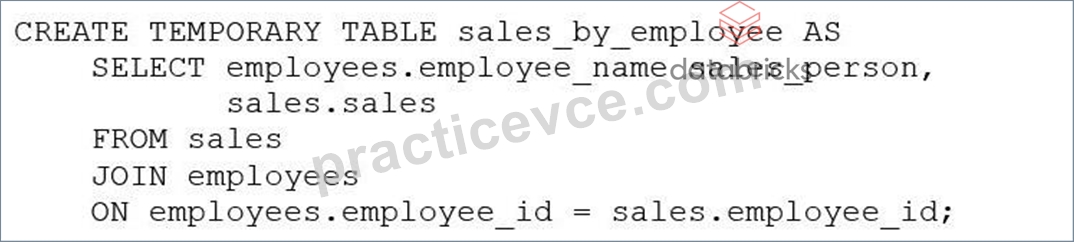
A business analyst has been asked to create a data entity/object called sales_by_employee. It should always stay up-to-date when new data are added to the sales table. The new entity should have the columns sales_person, which will be the name of the employee from the employees table, and sales, which will be all sales for that particular sales person. Both the sales table and the employees table have an employee_id column that is used to identify the sales person.
Which of the following code blocks will accomplish this task?
- A.

- B.

- C.
- D.

Answer: A
Explanation:
The SQL code provided in Option D is the correct way to create a view named sales_by_employee that will always stay up-to-date with the sales and employees tables. The code uses the CREATE OR REPLACE VIEW statement to define a new view that joins the sales and employees tables on the employee_id column. It selects the employee_name as sales_person and all sales for each employee, ensuring that the data entity/object is always up-to-date when new data are added to these tables.
NEW QUESTION # 24
A data analyst runs the following command:
INSERT INTO stakeholders.suppliers TABLE stakeholders.new_suppliers;
What is the result of running this command?
- A. The suppliers table now contains only the data from the new suppliers table.
- B. The command fails because it is written incorrectly.
- C. The suppliers table now contains both the data it had before the command was run and the data from the new suppliers table, including any duplicate data.
- D. The suppliers table now contains both the data it had before the command was run and the data from the new suppliers table, and any duplicate data is deleted.
- E. The suppliers table now contains the data from the new suppliers table, and the new suppliers table now contains the data from the suppliers table.
Answer: B
Explanation:
The command INSERT INTO stakeholders.suppliers TABLE stakeholders.new_suppliers is not a valid syntax for inserting data into a table in Databricks SQL. According to the documentation12, the correct syntax for inserting data into a table is either:
INSERT { OVERWRITE | INTO } [ TABLE ] table_name [ PARTITION clause ] [ ( column_name [, ...] ) | BY NAME ] query INSERT INTO [ TABLE ] table_name REPLACE WHERE predicate query The command in the question is missing the OVERWRITE or INTO keyword, and the query part that specifies the source of the data to be inserted. The TABLE keyword is optional and can be omitted. The PARTITION clause and the column list are also optional and depend on the table schema and the data source. Therefore, the command in the question will fail with a syntax error.
Reference:
INSERT | Databricks on AWS
INSERT - Azure Databricks - Databricks SQL | Microsoft Learn
NEW QUESTION # 25
A data organization has a team of engineers developing data pipelines following the medallion architecture using Delta Live Tables. While the data analysis team working on a project is using gold-layer tables from these pipelines, they need to perform some additional processing of these tables prior to performing their analysis.
Which of the following terms is used to describe this type of work?
- A. Data testing
- B. Data blending
- C. Last-mile
- D. Last-mile ETL
- E. Data enhancement
Answer: D
Explanation:
Last-mile ETL is the term used to describe the additional processing of data that is done by data analysts or data scientists after the data has been ingested, transformed, and stored in the lakehouse by data engineers. Last-mile ETL typically involves tasks such as data cleansing, data enrichment, data aggregation, data filtering, or data sampling that are specific to the analysis or machine learning use case. Last-mile ETL can be done using Databricks SQL, Databricks notebooks, or Databricks Machine Learning. Reference: Databricks - Last-mile ETL, Databricks - Data Analysis with Databricks SQL
NEW QUESTION # 26
Data professionals with varying titles use the Databricks SQL service as the primary touchpoint with the Databricks Lakehouse Platform. However, some users will use other services like Databricks Machine Learning or Databricks Data Science and Engineering.
Which of the following roles uses Databricks SQL as a secondary service while primarily using one of the other services?
- A. Business intelligence analyst
- B. Data engineer
- C. SQL analyst
- D. Data analyst
- E. Business analyst
Answer: B
Explanation:
Data engineers are primarily responsible for building, managing, and optimizing data pipelines and architectures. They use Databricks Data Science and Engineering service to perform tasks such as data ingestion, transformation, quality, and governance. Data engineers may use Databricks SQL as a secondary service to query, analyze, and visualize data from the lakehouse, but this is not their main focus. Reference: Databricks SQL overview, Databricks Data Science and Engineering overview, Data engineering with Databricks
NEW QUESTION # 27
A data analyst has created a Query in Databricks SQL, and now they want to create two data visualizations from that Query and add both of those data visualizations to the same Databricks SQL Dashboard.
Which of the following steps will they need to take when creating and adding both data visualizations to the Databricks SQL Dashboard?
- A. They will need to alter the Query to return two separate sets of results.
- B. They will need to add two separate visualizations to the dashboard based on the same Query.
- C. They will need to copy the Query and create one data visualization per query.
- D. They will need to create two separate dashboards.
- E. They will need to decide on a single data visualization to add to the dashboard.
Answer: B
Explanation:
A data analyst can create multiple visualizations from the same query in Databricks SQL by clicking the + button next to the Results tab and selecting Visualization. Each visualization can have a different type, name, and configuration. To add a visualization to a dashboard, the data analyst can click the vertical ellipsis button beneath the visualization, select + Add to Dashboard, and choose an existing or new dashboard. The data analyst can repeat this process for each visualization they want to add to the same dashboard. Reference: Visualization in Databricks SQL, Visualize queries and create a dashboard in Databricks SQL
NEW QUESTION # 28
......
Databricks Databricks-Certified-Data-Analyst-Associate Real 2024 Braindumps Mock Exam Dumps: https://vce4exams.practicevce.com/Databricks/Databricks-Certified-Data-Analyst-Associate-practice-exam-dumps.html