

TAKE SnowPro Advanced DSA-C03 PRACTICE QUESTIONS FOR AMAZING RESULTS
Snowflake DSA-C03 Exam Dumps Are Essential To Get Good Marks
NEW QUESTION # 114
You are tasked with identifying Personally Identifiable Information (PII) within a Snowflake table named 'customer data'. This table contains various columns, some of which may contain sensitive information like email addresses and phone numbers. You want to use Snowflake's data governance features to tag these columns appropriately. Which of the following approaches is the MOST effective and secure way to automatically identify and tag potential PII columns with the 'PII CLASSIFIED tag in your Snowflake environment, ensuring minimal manual intervention and optimal accuracy?
- A. Export the 'customer_data' to a staging area in cloud storage, use a third-party data discovery tool to scan for PII, and then manually apply the "PII_CLASSIFIED' tag to the corresponding columns in Snowflake based on the tool's findings.
- B. Use Snowflake's built-in classification feature with a pre-defined sensitivity category to identify potential PII columns. Associate a masking policy that redacts the data, and apply a tag 'PII_CLASSIFIED' via automated tagging to the columns identified as containing PII.
- C. Write a SQL script to query the 'INFORMATION SCHEMA.COLUMNS' view, identify columns with names containing keywords like 'email' or 'phone', and then apply the 'PII_CLASSIFIED tag to those columns.
- D. Create a custom Snowpark for Python UDF that uses regular expressions to analyze the data in each column and apply the 'PII_CLASSIFIED tag if a match is found. Schedule this UDF to run periodically using Snowflake Tasks.
- E. Manually inspect each column in the 'customer_data' table and apply the 'PII_CLASSIFIED' tag to columns that appear to contain PII based on their names and a small sample of data.
Answer: B
Explanation:
Snowflake's built-in classification feature is the most effective because it uses machine learning models to automatically identify sensitive data with a high degree of accuracy. Associating masking policies with the identified columns provides additional data protection. Automated tagging further streamlines the governance process. Option A, while viable, requires custom code and maintenance. Option C is manual and error-prone. Option D is based solely on column names and can lead to false positives and negatives. Option E introduces unnecessary complexity and security risks by exporting data.
NEW QUESTION # 115
A data scientist uses bootstrapping to estimate the sampling distribution of a statistic calculated from a dataset stored in Snowflake. They observe that the bootstrap distribution is significantly different from the original data distribution. Which of the following statements best describes the possible reasons for this difference, considering both the theoretical underpinnings of bootstrapping and potential limitations?
- A. The statistic being estimated is inherently unstable and has a high variance, causing the bootstrap distribution to be wider and potentially different in shape compared to the original data distribution. This is a normal outcome when dealing with such statistics.
- B. The difference is unexpected; the bootstrap distribution should always closely resemble the original data distribution, regardless of the statistic being estimated.
- C. Bootstrapping is only appropriate for normally distributed data; if the original data is not normal, the bootstrap distribution will inevitably differ significantly.
- D. The original sample may not be representative of the population, and the bootstrap procedure is simply amplifying the biases present in the original sample. Additionally, the statistic itself may be highly sensitive to outliers or specific data points, leading to a distorted bootstrap distribution.
- E. Bootstrapping always provides accurate estimates of sampling distributions, any significant difference indicates an error in the code implementation.
Answer: A,D
Explanation:
Options B and C are correct. Bootstrapping relies on the assumption that the original sample is representative of the population. If it isn't, the bootstrap distribution will reflect the biases of the sample. Also certain statistics, particularly those sensitive to outliers or with high variance, can produce bootstrap distributions that differ significantly from the original data distribution. Option A is incorrect because the bootstrap distribution doesn't necessarily have to be same as sample distribution. Option D is incorrect since Bootstrapping makes no assumptions regarding the distribution of original dataset and can be used for any data distribution. Option E is not correct. Bootstrapping is not always accurate and relies on assumptions to perform correctly.
NEW QUESTION # 116
You have trained a complex machine learning model using Snowpark for Python and are now preparing it for production deployment using Snowpark Container Services. You have containerized the model and pushed it to a Snowflake-managed registry. However, you need to ensure that only authorized users can access and deploy this model. Which of the following actions MUST you take to secure your model in the Snowflake Model Registry, ensuring appropriate access control, and minimizing the risk of unauthorized deployment or modification?
- A. Grant the 'USAGE privilege on the stage where the model files are stored to all users who need to deploy the model.
- B. Grant the 'READ privilege on the container registry to all users who need to deploy the model. Create a custom role with the 'APPLY MASKING POLICY privilege and grant this role to the deployment team.
- C. Store the model outside of Snowflake managed registry and use external authentication to control access.
- D. Grant the 'USAGE privilege on the database and schema containing the model registry, grant the 'READ privilege on the registry itself, and grant the EXECUTE TASK' privilege to the deployment team for the deployment task.
- E. Create a custom role, grant the USAGE' privilege on the database and schema containing the model registry, grant the 'READ privilege on the registry, and then grant this custom role to only those users authorized to deploy the model. Consider masking sensitive model parameters using masking policies.
Answer: E
Explanation:
Option D is the correct answer because it provides the most secure and granular access control. 'USAGE on the database and schema allows access to the container registry. 'READ on the registry allows viewing of model metadata without modification. Creating a custom role and granting it to specific users limits access to only authorized personnel. Utilizing masking policies further secures sensitive parameters. Option A is incorrect because it does not control access to the registry itself. 'USAGE privilege on a stage alone is insufficient for managing model registry access. Option B is incorrect because 'APPLY MASKING POLICY is not relevant for controlling access to the model registry. Option C is partially correct, but 'EXECUTE TASK' grants unnecessary privileges related to task execution, which is beyond the scope of registry access. It also lacks fine-grained control over who can deploy. Option E is incorrect because while it offers security, it bypasses the advantages of using Snowflake's managed registry.
NEW QUESTION # 117
You are developing a machine learning model within a Snowflake UDF (User-Defined Function) written in Python. This UDF needs to access external Python libraries not included in the default Snowflake Anaconda channel. You've created a stage and uploaded the necessary file. You've successfully used 'conda create' and 'conda install --file requirements.txt' to create your environment locally, and subsequently zipped the environment. Now, what steps are essential to configure the Snowflake UDF to correctly use these external libraries from the stage? Select all that apply.
- A. Include the line 'import sys; sys._xoptions['snowflake_home'] = at the top of your UDF to point to the environment stage location.
- B. Install the packages directly into the Snowflake environment using 'CREATE OR REPLACE FUNCTION RETURNS VARCHAR ..: and a pip install command within the function.
- C. Create a ZIP file containing the Python environment and upload it to a Snowflake stage.
- D. Set the 'PYTHON_VERSION' parameter of the 'CREATE OR REPLACE FUNCTION' statement to match the Python version used in your environment using e.g. 'PYTHON_VERSION = '3.8".
- E. Specify the stage path containing the zipped environment in the 'imports' clause of the 'CREATE OR REPLACE FUNCTION' statement using the symbol and specifying the zip file e.g., '@snowflake_packages/myenv.zip'.
Answer: C,D,E
Explanation:
Options B, C, and D are crucial. Snowflake UDFs can use custom environments created and uploaded as ZIP files to a stage. The 'imports' clause in the function definition must point to the ZIP file on the stage (Option C). The 'PYTHON_VERSION' must match the environment's Python version (Option D). Option B describes the process of creating a deployment-ready ZIP file. Option A's approach of manually setting 'sys._xoptions' is incorrect and not a recommended or supported method. Option E is not the standard way to manage external libraries; uploading a pre-built environment is more reliable and avoids dependency conflicts during UDF execution.
NEW QUESTION # 118
You are building a machine learning pipeline that uses data stored in Snowflake. You want to connect a Jupyter Notebook running on your local machine to Snowflake using Snowpark. You need to securely authenticate to Snowflake and ensure that you are using a dedicated compute resource for your Snowpark session. Which of the following approaches is the MOST secure and efficient way to achieve this?
- A. Configure OAuth authentication for your Snowflake account and use the OAuth token to establish a Snowpark session with a dedicated virtual warehouse.
- B. Use key pair authentication to connect to Snowflake, storing the private key securely on your local machine. Specify a dedicated virtual warehouse during session creation.
- C. Use the Snowflake Python connector with username and password and execute SQL commands to create a Snowpark DataFrame.
- D. Hardcode a role with 'ACCOUNTADMIN' privileges in your Jupyter Notebook using username and password.
- E. Store your Snowflake username and password directly in the Jupyter Notebook and create a Snowpark session using these credentials and the default Snowflake warehouse.
Answer: B
Explanation:
Option D is the most secure. Key pair authentication is more secure than username/password. Specifying a dedicated virtual warehouse ensures dedicated compute. Option A is highly insecure. Option B doesn't directly create a Snowpark session. Option C, while using OAuth, requires proper setup and key pair provides more control. Option E is highly insecure and grants excessive privileges.
NEW QUESTION # 119
You are a data scientist working for a retail company using Snowflake. You're building a linear regression model to predict sales based on advertising spend across various channels (TV, Radio, Newspaper). After initial EDA, you suspect multicollinearity among the independent variables. Which of the following Snowflake SQL statements or techniques are MOST appropriate for identifying and addressing multicollinearity BEFORE fitting the model? Choose two.
- A. Calculate the Variance Inflation Factor (VIF) for each independent variable using a user-defined function (UDF) in Snowflake that implements the VIF calculation based on R-squared values from auxiliary regressions. This requires fitting a linear regression for each independent variable against all others.
- B. Generate a correlation matrix of the independent variables using 'CORR aggregate function in Snowflake SQL and examine the correlation coefficients. Values close to +1 or -1 suggest high multicollinearity.
- C. Use ' on each independent variable to estimate its uniqueness. If uniqueness is low, multicollinearity is likely.
- D. Implement Principal Component Analysis (PCA) using Snowpark Python to transform the independent variables into uncorrelated principal components and then select only the components explaining a certain percentage of the variance.
- E. Drop one of the independent variable randomly if they seem highly correlated.
Answer: A,B
Explanation:
Multicollinearity can be identified by calculating the VIF for each independent variable. VIF is calculated by regressing each independent variable against all other independent variables and calculating 1/(1-RA2), where RA2 is the R-squared value from the regression. A high VIF suggests high multicollinearity. Correlation matrices generated with 'CORR can also reveal multicollinearity by showing pairwise correlations between independent variables. PCA using Snowpark is also a viable option, but less direct than VIF and correlation matrix analysis for identifying multicollinearity. APPROX_COUNT_DISTINCT is not directly related to identifying multicollinearity. Randomly dropping variables will also lead to data loss.
NEW QUESTION # 120
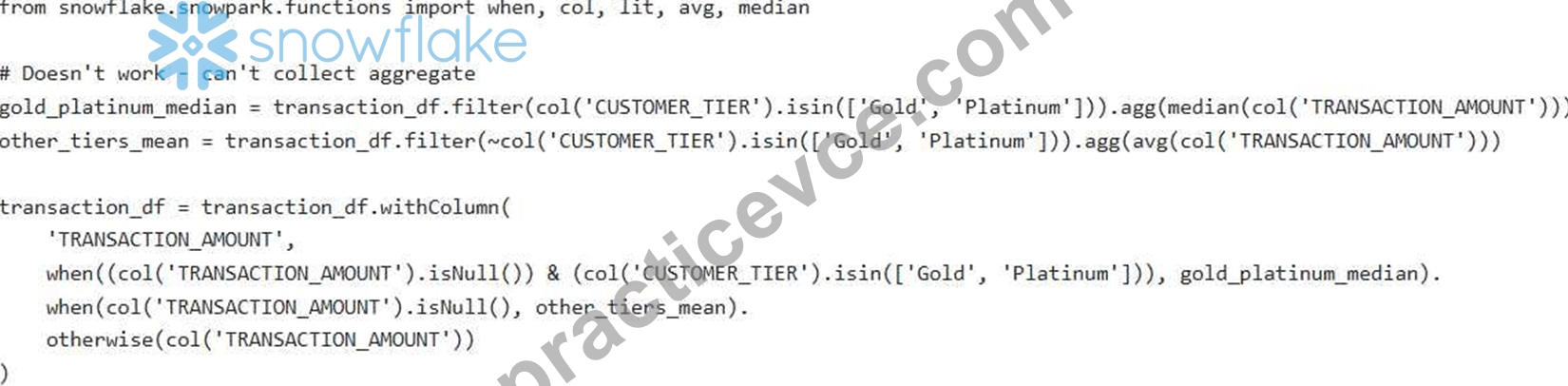
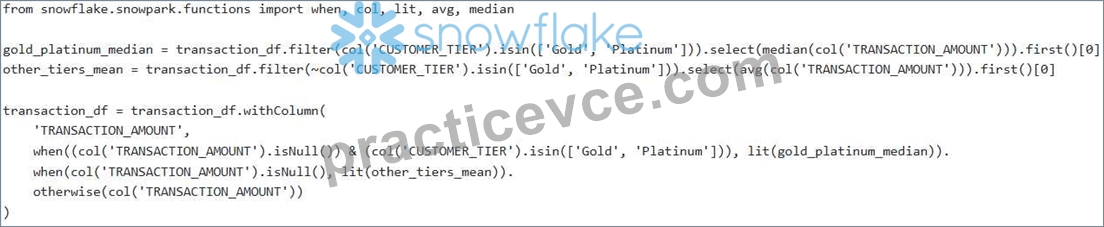
You are building a machine learning model using Snowpark for Python and have a feature column called 'TRANSACTION AMOUNT' in your 'transaction_df DataFrame. This column contains some missing values ('NULL). Your model is sensitive to missing data'. You want to impute the missing values using the median "TRANSACTION AMOUNT, but ONLY for specific customer segments (e.g., customers with a 'CUSTOMER TIER of 'Gold' or 'Platinum'). For other customer tiers, you want to impute with the mean. Which of the following Snowpark Python code snippets BEST achieves this selective imputation?
- A.

- B.
- C.
- D.

- E.

Answer: D
Explanation:
Option B is the most correct. It correctly calculates the median and mean for the specified customer segments using 'agg()' with .alias(y to name the resulting aggregate columns, and then retrieves the values using . This approach correctly handles the aggregation and retrieval of the calculated median and mean values. Option A uses which although technically works, is less readable than the aliased approach. The method provides similar performance benefits to the method with simpler syntax, as you retrieve only the first row of the DataFrame. 'toLocallterator' is a performant way to get local access to the result of an aggregation function when a small number of rows are expected. Option C fails because it attempts to use the aggregate directly without materializing the value. The comparison between using .agg(), .collect(), .first(), and .toLocallterator() demonstrates performance tuning knowledge.
NEW QUESTION # 121
A Snowflake table named 'SALES DATA contains a 'TRANSACTION DATE column stored as VARCHAR. The data in this column is inconsistent; some rows have dates in 'YYYY-MM-DD' format, others in 'MM/DD/YYYY' format, and some contain invalid date strings like 'N/A'. You need to standardize all dates to 'YYYY-MM-DD' format and store them in a new column called FORMATTED DATE in a new table 'STANDARDIZED_SALES DATA. Which of the following approaches, using Snowpark Python and SQL, most effectively handles these inconsistencies and minimizes errors during data transformation? Select all that apply:
- A. Creating a view on top of 'SALES_DATA' that implements the conversion logic. This avoids creating a new physical table immediately and allows for experimentation with different conversion strategies before materializing the data.
- B. Employing Snowpark's error handling mechanism (e.g., 'try...except' blocks) within a loop to iteratively convert each date string, catching and logging errors, and storing valid dates in a new column.
- C. Using a series of DATE" and 'TO_VARCHAR SQL functions in Snowpark to attempt converting the date in different formats and then formatting the result to 'YYYY-MM-DD'. Any conversion failing returns NULL.
- D. Using a single 'TO_DATE function with format parameter set to 'AUTO' combined with 'TO_VARCHAR to format the date to 'YYYY-MM-DD'.
- E. Using a Snowpark Python UDF to parse each date string individually, handling different formats with conditional logic, and returning a formatted date string. This provides flexibility in handling diverse date formats.
Answer: A,C
Explanation:
Options B and D are the most effective. Option B uses with different formats to handle inconsistencies. If a format fails, it returns NULL, providing a clean way to handle invalid dates. Combining this with VARCHAR formats the valid dates to 'YYYY-MM-DD'. Option D suggests creating a view. Views are useful for testing transformation logic without immediately impacting the base table, allowing experimentation before committing to a data transformation pipeline. Materializing the data into a table would be a subsequent step, after verifying the transformation's correctness. Option A, while flexible, is less performant because UDFs (User-Defined Functions) generally add overhead compared to built-in SQL functions. Option C is inefficient and not a recommended practice in Snowpark for vectorized operations. Option E will not work in most of the cases, as the AUTO parameter cannot reliably differentiate all provided formats. Furthermore, it does not account for data quality issues where there is no date format.
NEW QUESTION # 122
You have trained a linear regression model in Snowpark ML to predict house prices. After training, you want to assess the overall feature importance using the model's coefficients. Consider the following Snowflake table containing the coefficients:
Which of the following statements are correct interpretations of these coefficients regarding feature impact?
- A. The 'location_score' feature is the most influential predictor in determining house price.
- B. Increasing the number of bedrooms is associated with a decrease in the predicted house price.
- C. The 'age' feature has an insignificant impact because its coefficient is small.
- D. The 'bedrooms' feature has a positive impact on the house price since the coefficient is negative.
- E. An increase of one square foot (sqft) in house size is associated with an increase of $120.5 in the predicted house price.
Answer: A,B,E
Explanation:
Option A is correct because a positive coefficient for 'sqft' indicates a positive relationship with the target variable (house price). Option C is correct because 'location_score' has the largest absolute coefficient value. Option E is correct because a negative coefficient for 'bedrooms' indicates an inverse relationship. Option B is incorrect because the negative sign implies a negative impact. Option D is incorrect as the scale of features isn't normalized here, so we cannot conclude about the significance of the 'age' feature based on the magnitude of its coefficient alone without knowing its standard deviation and the standard deviation of other features. We would need to compute the z-score, t-score, or p-value for each coefficient to truly assess significance.
NEW QUESTION # 123
You are using Snowflake Cortex to analyze customer reviews. You have created a vector embedding for each review using a UDF that calls a remote LLM inference endpoint. Now you need to perform a similarity search to identify reviews that are similar to a given query review. Which of the following SQL queries leveraging vector functions in Snowflake is the MOST efficient and appropriate way to achieve this, assuming the 'REVIEW EMBEDDINGS' table has columns 'review_id' and 'embedding' (a VECTOR column) and query_embedding' is a pre-computed vector embedding?
- A. Option D
- B. Option A
- C. Option C
- D. Option B
- E. Option E
Answer: E
Explanation:
The most efficient and accurate way to perform a similarity search with vector embeddings is using ordered in descending order because inner product is the fastest of the vector functions and still gets the vector similarity score. The operator performs an exact match which doesn't consider vector similarity (A). is for array data, not vectors (B). 'QUALIFY' and 'VECTOR COSINE SIMILARITY works but isn't optimal (C), and L2 distance require some value/threshold to compare. 'ORDER BY ... LIMIT is efficient with the inner product, it's very fast (E).
NEW QUESTION # 124
You are building a machine learning model using Snowflake data to predict customer churn. Your dataset includes a 'CUSTOMER TYPE column with the following possible values: 'New', 'Returning', and 'VIP'. You need to perform one-hot encoding on this column. Which of the following Snowflake SQL queries correctly implements one-hot encoding for the 'CUSTOMER TYPE column, creating separate binary columns for each customer type ('IS NEW', 'IS RETURNING', 'IS VIP')?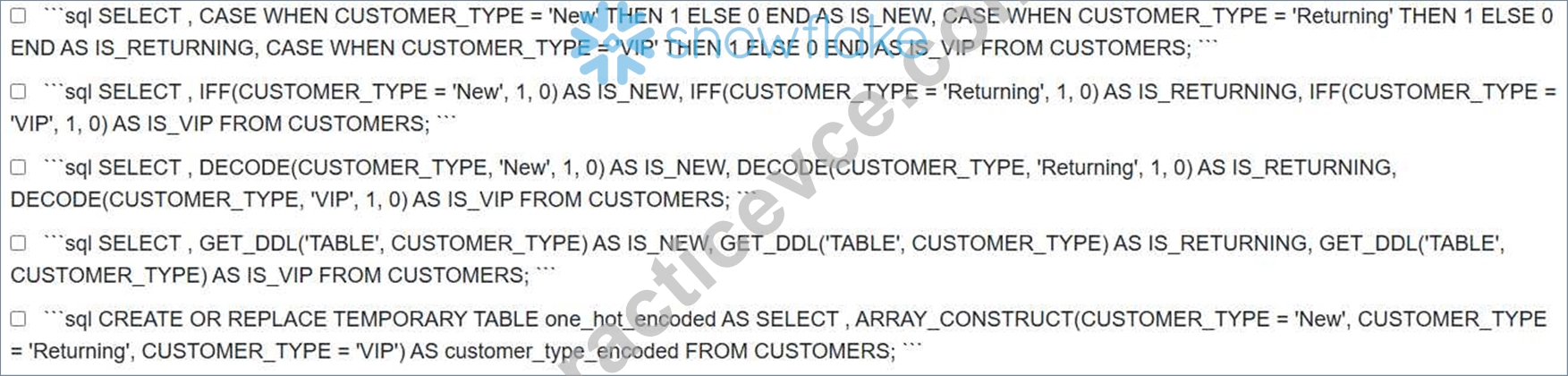
- A. Option D
- B. Option C
- C. Option B
- D. Option A
- E. Option E
Answer: B,C,D
Explanation:
Options A, B, and C are all valid ways to perform one-hot encoding in Snowflake. Option A uses the standard 'CASE statement, Option B leverages the 'IFF function (inline IF), and Option C uses 'DECODE , all achieving the same result of creating binary indicators for each category. Option D is incorrect because it uses GET DDL, which retrieves DDL statements, not for comparison. Option E is incorrect because it does not represent three seperate columns of binary columns for each customer type. Therefore, options A, B, and C are the correct approaches to generate separate binary columns for one-hot encoding.
NEW QUESTION # 125
You are working with a dataset containing timestamps representing website user activity. The timestamps are stored as strings in the format 'YYYY-MM-DD HH:MI:SS.SSSSSS' in a Snowflake table named 'website_activity'. You need to extract the hour of the day from these timestamps and encode it as a cyclical feature using sine and cosine transformations. This is to capture the cyclical nature of user activity throughout the day (e.g., 23:00 and 00:00 are close in time). Which of the following Snowflake SQL code snippets correctly implements this cyclical encoding and creates the 'hour_sin' and 'hour_cos' columns?
- A.

- B.

- C.

- D.

- E.

Answer: B
Explanation:
Option A is correct. It properly casts the timestamp string to a TIMESTAMP data type using 'CAST(activity_timestamp AS TIMESTAMP) , extracts the hour using 'EXTRACT(HOUR FROM ... y , and applies the sine and cosine transformations to create the cyclical features. Options B, C, and D might contain syntax errors or incorrect functions. Using SUBSTRING to extract can be prone to errors as it doesn't perform data validation. Option E also works but it uses a MOD function which is redundant. Therefore, it is less preferable to Option A.
NEW QUESTION # 126
You are analyzing website traffic data stored in a Snowflake table named 'WEB EVENTS. This table contains a 'TIMESTAMP' column representing when the event occurred and a 'PAGE VIEWS column indicating the number of page views for that event. You need to identify the day with the highest number of page views and also the day with lowest number of page views along with average number of page views. How can you accomplish this using Snowflake SQL?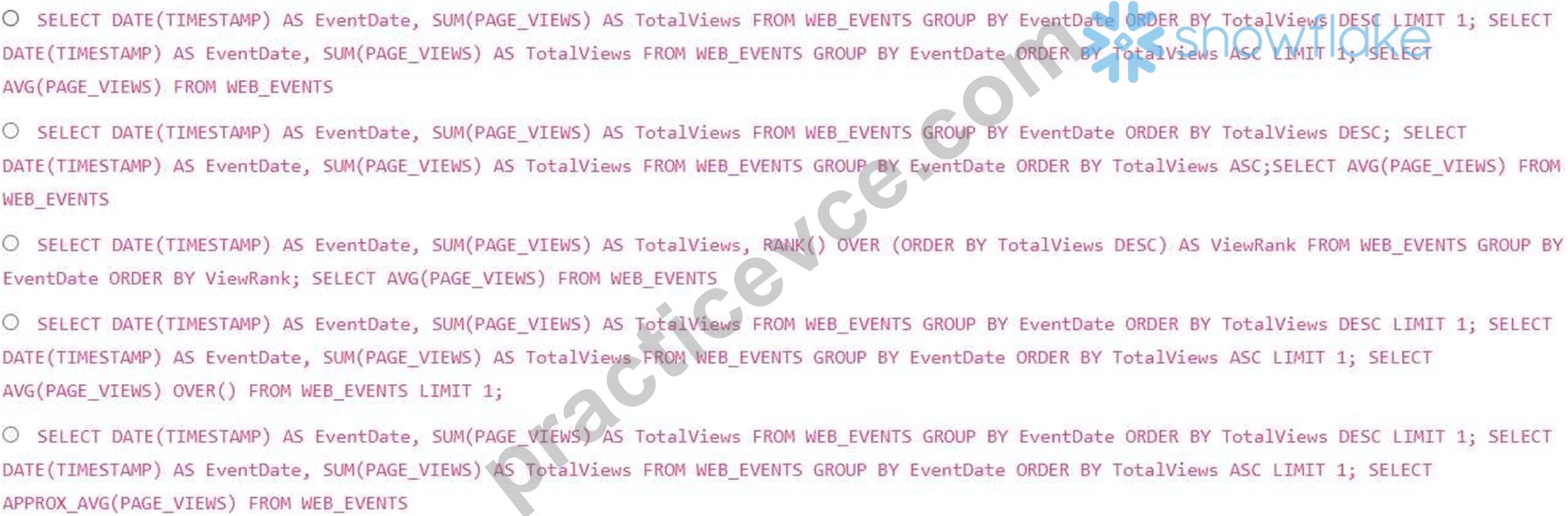
- A. Option A
- B. Option C
- C. Option E
- D. Option D
- E. Option B
Answer: D
Explanation:
Option D provides the correct answer. The first two queries correctly identify the day with the highest and lowest total views, respectively, using 'DATE(TIMESTAMP)' to extract the date, to aggregate page views, 'GROUP BY' to group by date, "ORDER BY' to sort, and 'LIMIT 1' to select only the top/bottom day. It also has the correct query to identify average page views 'SELECT OVER() FROM WEB_EVENTS LIMIT Other Options A and E are quite close but they don't identify the same, in option A, 'SELECT AVG(PAGE_VIEWS) FROM WEB_EVENTS' , the AVG page views won't tell us the dates of min max and Avg views. Similar is the problem with option E, 'SELECT FROM WEB_EVENTS The APPROX_AVG won't tell us which day has highest or lowest.
NEW QUESTION # 127
You are analyzing sensor data collected from industrial machines, which includes temperature readings. You need to identify machines with unusually high temperature variance compared to their peers. You have a table named 'sensor _ readings' with columns 'machine_id', 'timestamp', and 'temperature'. Which of the following SQL queries will help you identify machines with a temperature variance that is significantly higher than the average temperature variance across all machines? Assume 'significantly higher' means more than two standard deviations above the mean variance.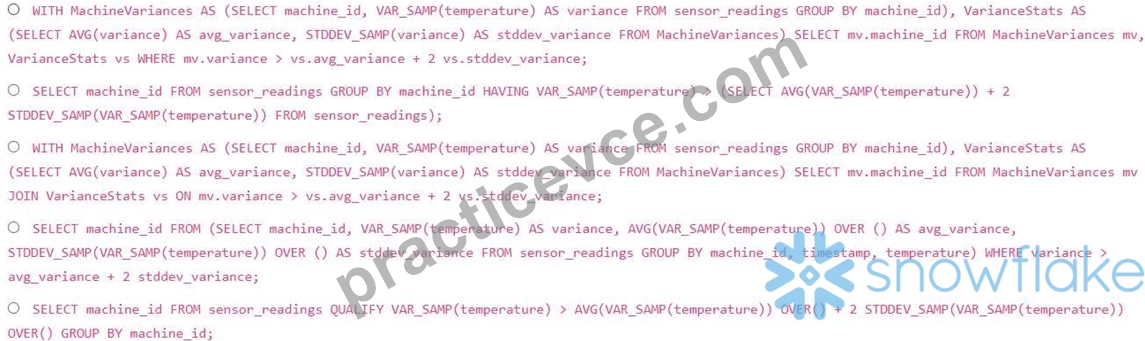
- A. Option D
- B. Option C
- C. Option A
- D. Option E
- E. Option B
Answer: C
Explanation:
The correct answer is A. This query first calculates the variance for each machine using a CTE (Common Table Expression). Then, it calculates the average variance and standard deviation of variances across all machines. Finally, it selects the machine IDs where the variance is more than two standard deviations above the average variance. Option B is incorrect because it tries to calculate aggregate functions within the HAVING clause without proper grouping. Option C uses a JOIN which is inappropriate in this scenario. Option D is incorrect because the window functions will not return the correct aggregate values. Option E is syntactically incorrect. QUALIFY clause should have partition BY statement.
NEW QUESTION # 128
You are working on a customer churn prediction project. One of the features you want to normalize is 'customer_age'. However, a Snowflake table constraint ensures that all 'customer_age' values are between 0 and 120 (inclusive). Furthermore, you want to avoid using any stored procedures and prefer a pure SQL approach for data transformation. Considering these constraints, which normalization technique and associated SQL query is the most appropriate in Snowflake for this scenario, guaranteeing that the scaled values remain within a predictable range?
- A. Min-Max scaling directly to the range [0, 1] using the known bounds (0 and 120):

- B. Z-score standardization:

- C. Box-Cox transformation:

- D. Z-score standardization after clipping values outside 1 and 99 percentile:

- E. Min-Max scaling to the range [0, 1]:

Answer: A
Explanation:
Option D is the most appropriate. Given the existing constraint on 'customer_age' (0-120), and the requirement to avoid stored procedures, directly scaling to the range [0, 1] using the known minimum and maximum values is efficient and guarantees the output remains within a predictable range. This approach avoids data-dependent calculations (like MIN and MAX over the entire dataset) which are unnecessary given the constraint. Option A won't guarantee values within [0, 1]. Option B is correct but option D is the efficient solution to get the expected outcome and avoid cost and complexity. Option C would not scale to between O and 1 and adds complexity. Option E is not a normalization technique.
NEW QUESTION # 129
You have implemented a Python UDTF in Snowflake to train a machine learning model incrementally using incoming data'. The UDTF performs well initially, but as the volume of data processed increases significantly, you observe a noticeable degradation in performance and an increase in query execution time. You suspect that the bottleneck is related to the way the model is being updated and persisted within the UDTF. Which of the following optimization strategies, or combination of strategies, would be MOST effective in addressing this performance issue?
- A. Leverage Snowflake's external functions and a cloud-based ML platform (e.g., SageMaker, Vertex A1) to offload the model training process. The UDTF would then only be responsible for data preparation and calling the external function.
- B. Persist the trained model to a Snowflake stage after each batch update. Use a separate UDF (User-Defined Function) to load the model from the stage before processing new data. This decouples model training from inference.
- C. Instead of updating the model incrementally within the UDTF for each row, batch the incoming data into larger chunks and perform model updates only on these batches. Use Snowflake's VARIANT data type to store these batches temporarily.
- D. Use the 'cachetools' library within the UDTF to cache intermediate results and reduce redundant calculations during each function call. Configure the cache with a maximum size and eviction policy appropriate for the data volume.
- E. Rewrite the UDTF in Java or Scala, as these languages generally offer better performance compared to Python for computationally intensive tasks. Use the same machine learning libraries that you used with Python.
Answer: A,B,C
Explanation:
Options B, C, and D offer the most effective strategies for optimizing performance when training a model incrementally with a Python UDTF in Snowflake. Batching updates (B) reduces the overhead of model updates. Persisting the model to a Snowflake stage (C) decouples training from inference and allows for model reuse. Offloading training to an external function (D) leverages dedicated ML infrastructure. Caching (A) might offer some marginal improvement but is unlikely to address the core performance bottleneck. While Java or Scala (E) can be faster than Python, rewriting the UDTF is a significant undertaking and might not be necessary if other optimization strategies are applied effectively. Also the question is specific about Python. In summary, consider batching and persistence as key in performance optimization.
NEW QUESTION # 130
You've developed a binary classification model using Snowpark ML to predict customer subscription renewal (0 for churn, 1 for renew). You want to visualize feature importance using a permutation importance technique calculated within Snowflake. You perform feature permutation and calculate the decrease in model performance (e.g., AUC) after each permutation. Suppose the following query represents the results of this process:
The 'feature_importance_results' table contains the following data:
Based on this output, which of the following statements are the MOST accurate interpretations regarding feature impact and model behavior?
- A. The 'support_calls' feature is the least important feature; removing it entirely from the model will have little impact on its AUC performance.
- B. The 'contract_length' feature is the most important feature for the model's predictive performance; shuffling it causes the largest drop in AUC.
- C. The 'contract_length' and 'monthly_charges' features are equally important.
- D. Increasing the 'contract_length' for customers will always lead to a higher probability of renewal. However, there could be correlation between contract length and monthly charges.
- E. Permutation importance only reveals the importance of features within the current model. Different models trained with different features or algorithms might have different feature rankings.
Answer: A,B,E
Explanation:
Option A is correct because permutation importance measures the decrease in model performance after a feature is randomly shuffled. A larger decrease indicates a higher importance. Option B is correct; a small 'mean_auc_decrease' for 'support_calls' indicates it has minimal impact, implying its removal won't drastically affect AUC. Option E is correct as permutation importance is model-specific and dataset-specific. The features considered important may vary across model types or even the samples used in training. Option C is incorrect. 0.25 is not equivalent to 0.15. Option D is incorrect because permutation importance doesn't directly translate to a causal relationship between feature values and the target variable (renewal). There could be confounding factors or non-linear relationships.
NEW QUESTION # 131
You are tasked with deploying a time series forecasting model within Snowflake using Snowpark Python. The model requires significant pre-processing and feature engineering steps that are computationally intensive. These steps include calculating rolling statistics, handling missing values with imputation, and applying various transformations. You aim to optimize the execution time of these pre- processing steps within the Snowpark environment. Which of the following techniques can significantly improve the performance of your data preparation pipeline?
- A. Write the feature engineering logic directly in SQL and create a view. Use the Snowpark DataFrame API to query the view, avoiding Python code execution within Snowpark.
- B. Utilize Snowpark's vectorized UDFs and DataFrame operations to leverage Snowflake's distributed computing capabilities.
- C. Force single-threaded execution by setting to avoid overhead associated with parallel processing.
- D. Ensure that all data used is small enough to fit within the memory of the client machine running the Snowpark Python script, thus removing the need for distributed computing.
- E. Convert the Snowpark DataFrame to a Pandas DataFrame using and perform all pre-processing operations using Pandas functions before loading the processed data back to Snowflake.
Answer: A,B
Explanation:
Vectorized UDFs and SQL Views are the key to optimizing data pre-processing. Options B and E are correct. B - Utilize Snowpark's vectorized UDFs and DataFrame operations: Snowpark is designed to push computation down to Snowflake's distributed compute engine. Vectorized UDFs allow you to execute Python code in a parallel and efficient manner directly within Snowflake. E - SQL View: Snowpark DataFrame API can query the view from SQL directly. Writing the data preparation logic in SQL leverages the snowflake's engine more effectively than Pandas or Python on a client machine. Options A, C, and D are generally incorrect: Option A is incorrect as it defeats the purpose of using Snowpark. Parallel execution is generally much faster. Option C is incorrect as moving data outside of snowflake is costly. Option D is incorrect. Snowpark is designed to manage a large scale of data.
NEW QUESTION # 132
You are working with a Snowflake table named 'CUSTOMER DATA' that contains personally identifiable information (PII), including customer names, email addresses, and phone numbers. Your team needs to perform exploratory data analysis on this data to understand customer demographics and behavior. However, you must ensure that the PII is protected and that only authorized personnel can access the sensitive information. Which of the following strategies should you implement in Snowflake to achieve secure EDA?
- A. Apply dynamic data masking to the entire 'CUSTOMER_DATA' table, masking all columns by default, and provide decryption keys only to authorized users.
- B. Create a copy of the 'CUSTOMER DATA table without the PII columns and grant 'SELECT' privileges on this copy to the data scientists. Use masking policies on the original table.
- C. Use transient tables to store the customer data after PII is obfuscated, drop the table and reload new data daily.
- D. Create a view on top of that excludes the PII columns (e.g., name, email, phone). Grant 'SELECT privileges on this view to data scientists. Also implement data masking policies on the 'CUSTOMER DATA' table for the PII columns and grant 'SELECT on the table to specific roles requiring access to the masked values.
- E. Grant 'SELECT privileges on the 'CUSTOMER DATA' table to all data scientists, and rely on them to avoid querying PII columns directly.
Answer: B,D
Explanation:
Options B and E are both valid strategies. Option B provides a view with non-PII data, while using masking policies on the table. Option E creates a copy of the 'CUSTOMER_DATR table and leverages masking on original table. Option A is insecure. Option C while obfuscating the PII, will lead to data loss and will be costly to move the data. Option D isn't practical, it would overly restrict access.
NEW QUESTION # 133
You are tasked with building a machine learning pipeline in Snowpark Python to predict customer lifetime value (CLTV). You need to access and manipulate data residing in multiple Snowflake tables and views, including customer demographics, purchase history, and website activity. To improve code readability and maintainability, you decide to encapsulate data access and transformation logic within a Snowpark Stored Procedure. Given the following Python code snippet representing a simplified version of your stored procedure:
- A. The 'session.sql('SELECT FROM PURCHASE line executes a SQL query against the Snowflake database and returns the results as a list of Row objects.
- B. The 'session.write_pandas(df, table_name='CLTV PREDICTIONS', auto_create_table=Truey function writes the Pandas DataFrame 'df containing the CLTV predictions directly to a new Snowflake table named , automatically creating the table if it does not exist.
- C. The 'snowflake.snowpark.context.get_active_session()' function retrieves the active Snowpark session object, enabling interaction with the Snowflake database from within the stored procedure.
- D. The replace=True, packages=['snowflake-snowpark-python', 'pandas', decorator registers the Python function as a Snowpark Stored Procedure, allowing it to be called from SQL.
- E. The 'session.table('CUSTOMER DEMOGRAPHICS')' method creates a local Pandas DataFrame containing a copy of the data from the 'CUSTOMER DEMOGRAPHICS' table.
Answer: A,B,C,D
Explanation:
Option A is correct because is the standard method for accessing the active Snowpark session within a stored procedure. Option C is correct as the gsproc' decorator is required to register the function as a Snowpark Stored Procedure, specifying necessary packages. Option D correctly explains how to execute SQL queries using the session object and retrieve results. Option E accurately describes the function's ability to write a Pandas DataFrame to a Snowflake table and create it if it doesn't exist. Option B is incorrect because returns a Snowpark DataFrame, not a Pandas DataFrame. A Snowpark DataFrame is a lazily evaluated representation of the data, while a Pandas DataFrame is an in-memory copy.
NEW QUESTION # 134
You're deploying a pre-trained model for fraud detection that's hosted as a serverless function on Google Cloud Functions. This function requires two Snowflake tables: 'TRANSACTIONS (containing transaction details) and 'CUSTOMER PROFILES (containing customer information), to be joined and used as input for the model. The external function in Snowflake, 'DETECT FRAUD', should process batches of records efficiently. Which of the following approaches are most suitable for optimizing data transfer and processing between Snowflake and the Google Cloud Function?
- A. Serialize the joined 'TRANSACTIONS' and 'CUSTOMER_PROFILES data into a large CSV file, store it in a cloud storage bucket, and then pass the URL of the CSV file to the 'DETECT FRAUD function.
- B. Utilize Snowflake's external functions feature to send batches of data from the joined 'TRANSACTIONS' and 'CUSTOMER PROFILES tables to the 'DETECT_FRAUD function in a structured format (e.g., JSON) using HTTP requests. Implement proper error handling and retry mechanisms.
- C. Create a Snowflake pipe that automatically streams new transaction data to the Google Cloud Function whenever new records are inserted into the 'TRANSACTIONS' table, triggering the fraud detection model in real-time.
- D. Within the 'DETECT FRAUD function, execute SQL queries directly against Snowflake using the Snowflake JDBC driver to fetch the necessary data from the "TRANSACTIONS' and 'CUSTOMER PROFILES' tables.
- E. Use Snowflake's Java UDF functionality to directly connect to the Google Cloud Function's database, bypassing the need for an external function or data transfer through HTTP.
Answer: B
Explanation:
Option D is the most appropriate. External functions are designed for this type of integration, allowing Snowflake to send batches of data to external services for processing. Using JSON provides a structured and efficient way to transfer the data. Option A is inefficient due to the overhead of writing and reading large files. Option B bypasses external functions which defeats the purpose of the question and also is not a standard integration pattern. Option C is not recommended as Snowflake is better at parallel processing. Option E would be appropriate for real- time streaming and fraud detection use case but involves much more setup than a single function invocation, so is a possible but not the most practical choice.
NEW QUESTION # 135
You have trained a classification model in Snowflake using Snowpark ML to predict customer churn. After deploying the model, you observe that the model performs well on the training data but poorly on new, unseen data'. You suspect overfitting. Which of the following strategies can be applied within Snowflake to detect and mitigate overfitting during model validation , considering the model is already deployed and receiving inference requests through a Snowflake UDF?
- A. Monitor the UDF execution time in Snowflake. A sudden increase in execution time indicates overfitting. Use the 'EXPLAIN' command on the UDF's underlying SQL query to identify performance bottlenecks and rewrite the query for optimization.
- B. Calculate the Area Under the Precision-Recall Curve (AUPRC) using Snowflake SQL on both the training and validation datasets. A significant difference indicates overfitting. Then, retrain the model in Snowpark ML with added L1 or L2 regularization, adjusting the regularization strength based on validation set performance, and redeploy the UDF.
- C. Implement k-fold cross-validation within the Snowpark ML training pipeline using Snowflake's distributed compute. Track the mean and standard deviation of the performance metrics (e.g., accuracy, Fl-score) across folds. A high variance suggests overfitting. Use this information to tune hyperparameters or select a simpler model architecture before deployment.
- D. Create shadow UDFs that score data using alternative models. Compare the performance metrics (such as accuracy, precision, recall) between the production UDF and shadow UDFs using Snowflake's query capabilities. If shadow models consistently outperform the production model on certain data segments, retrain the production model incorporating those data segments with higher weights.
- E. Since the model is already deployed, the only option is to collect inference requests and compare the distributions of predicted values in each batch with the predicted values on the training set. A large difference indicates overfitting; model must be retrained outside of the validation process.
Answer: B,C
Explanation:
Options A and C are correct because they describe strategies for detecting and mitigating overfitting during the model validation process using Snowflake's capabilities. AUPRC is a good performance metric to compare the training vs validation set results to catch overfitting, and regularization can be used to avoid overfitting. Option C directly incorporates cross-validation into the model training workflow within Snowflake, allowing for early detection and mitigation of overfitting through hyperparameter tuning and model selection. Option B is incorrect because it focuses on performance optimization, not overfitting. Option D describes an AIB testing or champion-challenger setup which could be a strategy to use to detect data drift over time, but not overfitting. E is only partially correct as it describes one way to detect data drift, but not overfitting.
NEW QUESTION # 136
......
Latest Snowflake DSA-C03 Dumps with Test Engine and PDF (New Questions): https://vce4exams.practicevce.com/Snowflake/DSA-C03-practice-exam-dumps.html