

[Nov-2025] 100% Actual CAS-004 dumps Q&As with Explanations Verified & Correct Answers
CAS-004 Dumps with Free 365 Days Update Fast Exam Updates
NEW QUESTION # 114
An organization's assessment of a third-party, non-critical vendor reveals that the vendor does not have cybersecurity insurance and IT staff turnover is high. Theorganization uses the vendor to move customer office equipment from one service location to another. The vendor acquires customer data and access to the business via an API.
Given this information, which of the following is a noted risk?
- A. Financial liability from a vendor data breach
- B. Feature delay due to extended software development cycles
- C. Technical impact to the API configuration
- D. The possibility of the vendor's business ceasing operations
Answer: B
Explanation:
Reference: https://legal.thomsonreuters.com/en/insights/articles/data-breach-liability
NEW QUESTION # 115
A security analyst discovered that the company's WAF was not properly configured. The main web server was breached, and the following payload was found in one of the malicious requests:
Which of the following would BEST mitigate this vulnerability?
- A. CAPTCHA
- B. Network intrusion prevention
- C. Input validation
- D. Data encoding
Answer: C
NEW QUESTION # 116
After the latest risk assessment, the Chief Information Security Officer (CISO) decides to meet with the development and security teams to find a way to reduce the security task workload. The CISO would like to:
- Have a solution that uses API to communicate with other security
tools.
- Use the latest technology possible.
- Have the highest controls possible on the solution.
Which of following is the BEST option to meet these requirements?
- A. CSP
- B. EDR
- C. CASB
- D. SOAR
Answer: D
Explanation:
Security Orchestration, Automation, and Response (SOAR) solutions are designed to automate and streamline security operations in complex environments. By utilizing APIs, SOAR platforms can integrate with various security tools to enhance incident response processes, automate tasks, and improve overall efficiency. This aligns with the requirements of using the latest technology and having high control over the solution. SOAR's ability to orchestrate between different security solutions and automate responses to threats makes it the best option to reduce the security task workload while maintaining high controls.
NEW QUESTION # 117
An enterprise's Chief Technology Officer (CTO) and Chief Information Security Officer (CISO) are meeting to discuss ongoing capacity and resource planning issues. The enterprise has experienced rapid, massive growth over the last 12 months, and the technology department is stretched thin for resources. A new accounting service is required to support the enterprise's growth, but the only available compute resources that meet the accounting service requirements are on the virtual platform, which is hosting the enterprise's website.
Which of the following should the CISO be MOST concerned about?
- A. Transferring as many services as possible to a CSP could free up resources.
- B. A security vulnerability that is exploited on the website could expose the accounting service.
- C. Poor capacity planning could cause an oversubscribed host, leading to poor performance on the company's website.
- D. The CTO does not have the budget available to purchase required resources and manage growth.
Answer: B
NEW QUESTION # 118
A recent data breach revealed that a company has a number of files containing customer data across its storage environment. These files are individualized for each employee and are used in tracking various customer orders, inquiries, and issues. The files are not encrypted and can be accessed by anyone. The senior management team would like to address these issues without interrupting existing processes.
Which of the following should a security architect recommend?
- A. A CMDB to report on systems that are not configured to security baselines
- B. An ERP program to identify which processes need to be tracked
- C. A DLP program to identify which files have customer data and delete them
- D. A CRM application to consolidate the data and provision access based on the process and need
Answer: D
NEW QUESTION # 119
A bank hired a security architect to improve its security measures against the latest threats The solution must meet the following requirements
* Recognize and block fake websites
* Decrypt and scan encrypted traffic on standard and non-standard ports
* Use multiple engines for detection and prevention
* Have central reporting
Which of the following is the BEST solution the security architect can propose?
- A. EDR
- B. NGFW
- C. Web filtering
- D. CASB
Answer: B
Explanation:
A next-generation firewall (NGFW) is a device or software that provides advanced network security features beyond the traditional firewall functions. A NGFW can provide the following capabilities:
Recognize and block fake websites, using URL filtering and reputation-based analysis Decrypt and scan encrypted traffic on standard and non-standard ports, using SSL/TLS inspection and deep packet inspection Use multiple engines for detection and prevention, such as antivirus, intrusion prevention system (IPS), application control, and sandboxing Have central reporting, using a unified management console and dashboard A cloud access security broker (CASB) is a device or software that acts as an intermediary between cloud service users and cloud service providers. A CASB can provide various security functions such as visibility, compliance, data security, and threat protection, but it does not provide all the capabilities of a NGFW. Web filtering is a technique that blocks or allows web access based on predefined criteria such as categories, keywords, or reputation. Web filtering can help recognize and block fake websites, but it does not provide all the capabilities of a NGFW. Endpoint detection and response (EDR) is a technology that monitors and analyzes the activity and behavior of endpoints such as computers or mobile devices. EDR can help detect and respond to advanced threats, but it does not provide all the capabilities of a NGFW. Reference: [CompTIA Advanced Security Practitioner (CASP+) Certification Exam Objectives], Domain 2: Enterprise Security Architecture, Objective 2.2: Select appropriate hardware and software solutions
NEW QUESTION # 120 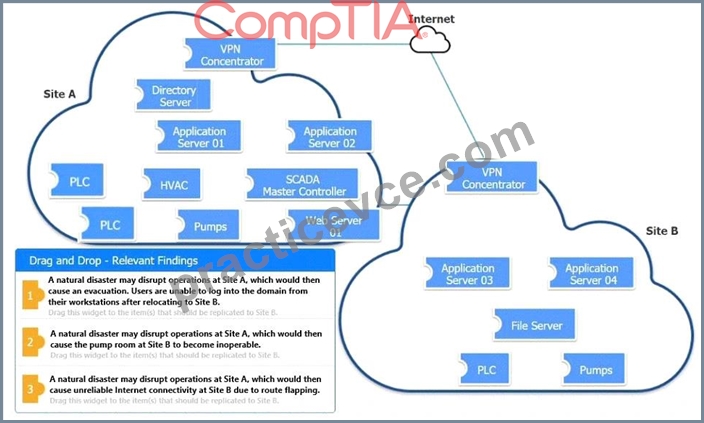
An organization is planning for disaster recovery and continuity of operations.
INSTRUCTIONS
Review the following scenarios and instructions. Match each relevant finding to the affected host.
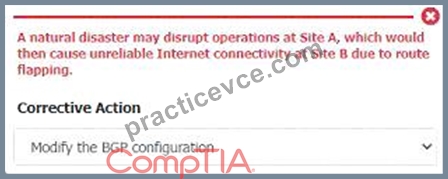
After associating scenario 3 with the appropriate host(s), click the host to select the appropriate corrective action for that finding.
Each finding may be used more than once.
If at any time you would like to bring back the initial state of the simul-ation, please click the Reset All button.
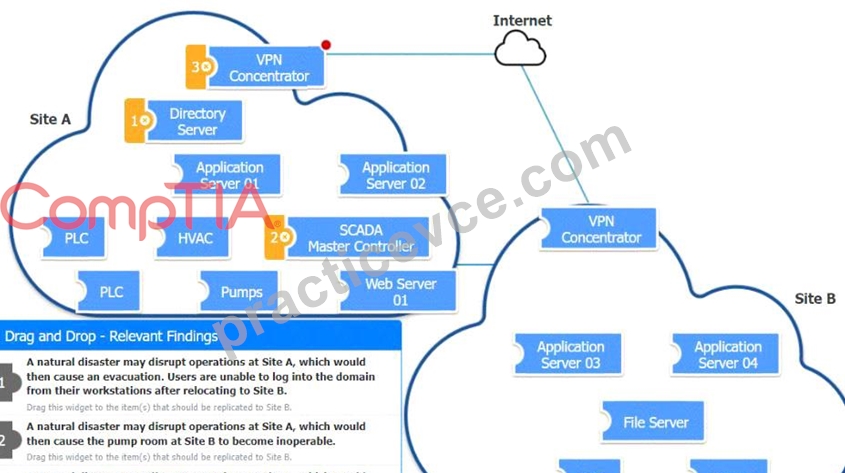
Answer:
Explanation: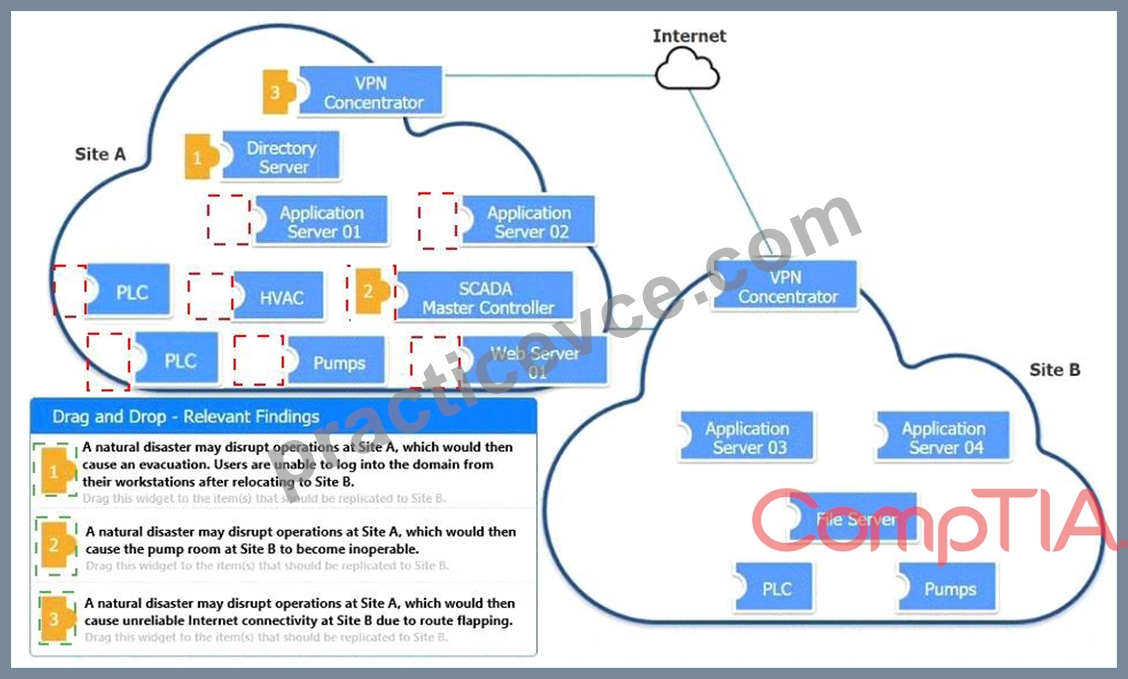
NEW QUESTION # 121
A security engineer has been informed by the firewall team that a specific Windows workstation is part of a command-and-control network.
The only information the security engineer is receiving is that the traffic is occurring on a non-standard port (TCP 40322).
Which of the following commands should the security engineer use FIRST to find the malicious process?
- A. ipconfig
- B. tcpdump
- C. netstar
- D. tasklist
- E. traceroute
Answer: C
Explanation:
Netstat is a command-line tool that can be used to find the malicious process that is using a specific port on a Windows workstation. Netstat displays active TCP connections, ports on which the computer is listening, Ethernet statistics, the IP routing table, IPv4 statistics (for the IP, ICMP, TCP, and UDP protocols), and IPv6 statistics (for the IPv6, ICMPv6, TCP over IPv6, and UDP over IPv6 protocols). To find the process that is using a specific port, such as TCP 40322, the security engineer can use the following command:
netstat -ano | findstr :40322
This command will filter the netstat output by the port number and show the process identifier (PID) of the process that is using that port. The security engineer can then use the task manager or another tool to identify and terminate the malicious process by its PID. Verified References:
https://docs.microsoft.com/en-us/windows-server/administration/windows-commands/netstat
https://www.howtogeek.com/28609/how-can-i-tell-what-is-listening-on-a-tcpip-port-in-windows/
NEW QUESTION # 122
A security analyst discovered that a database administrator's workstation was compromised by malware. After examining the Jogs. the compromised workstation was observed connecting to multiple databases through ODBC. The following query behavior was captured:
Assuming this query was used to acquire and exfiltrate data, which of the following types of data was compromised, and what steps should the incident response plan contain?
A) Personal health information: Inform the human resources department of the breach and review the DLP logs.
#) Account history; Inform the relationship managers of the breach and create new accounts for the affected users.
C) Customer IDs: Inform the customer service department of the breach and work to change the account numbers.
D) PAN: Inform the legal department of the breach and look for this data in dark web monitoring.
- A. Option A
- B. Option C
- C. Option B
- D. Option D
Answer: D
NEW QUESTION # 123
A security analyst discovered that the company's WAF was not properly configured. The main web server was breached, and the following payload was found in one of the malicious requests:
php-template
CopyEdit
<!DOCTYPE doc [
<!ELEMENT doc ANY >
<!ENTITY xxe SYSTEM "file:///etc/passwd" >
<doc>&xxe;</doc>
]>
Which of the following wouldbestmitigate this vulnerability?
- A. CAPTCHA
- B. Network intrusion prevention
- C. Input validation
- D. Data encoding
Answer: C
Explanation:
Comprehensive and Detailed in-Depth Explanation:
Understanding the Vulnerability:
The payload presented is a classic example of anXML External Entity (XXE) attack.
In this attack, an attacker exploits improperly configured XML parsers to includeexternal entitiesthat can read sensitive files, such as/etc/passwdon Linux systems.
XXE vulnerabilities occur when:
XML input containing aDOCTYPEdeclaration is processed.
The parser is configured to resolve external entities.
Why the Correct Answer is B (Input validation):
Input validationis the most effective way to prevent XXE attacks.
Proper validation ensures thatmalicious XML entities are not accepted or processed.
Techniques to mitigate XXE include:
Disabling DTDs (Document Type Definitions)in XML parsers.
Implementingsecure parser configurationsthat do not process external entities.
Performingschema validationto restrict allowed XML elements.
Many modern XML parsers provide options todisable external entity processingentirely, significantly reducing the risk of XXE.
Why the Other Options Are Incorrect:
A: CAPTCHA:
CAPTCHAs prevent automated bots from interacting with web forms but donot mitigate XML parser vulnerabilities.
CAPTCHAs addressautomated input, notmalicious payloads.
C: Data encoding:
Encoding data can preventinjection attacks, such as XSS, but it does not specifically address the issue ofexternal entity resolutionin XML.
Encoding cannot prevent the parser from interpretingDOCTYPEor external entity references.
D: Network intrusion prevention:
AnNIPS (Network Intrusion Prevention System)may detect some XXE attempts but isnot the primary method of prevention.
Relying solely on network-level security does not address theapplication-layer vulnerabilityitself.
Additional Best Practices:
Use libraries or frameworks that do not support XML parsing oruse safer alternatives like JSON.
Regularly update XML parsers to the latest version to patch known vulnerabilities.
Conductregular security testing(like dynamic analysis) to identify XXE risks.
Extract from CompTIA SecurityX CAS-005 Study Guide:
According to theCompTIA SecurityX CAS-005 Official Study Guide, XXE vulnerabilities can be mitigated bydisabling external entity processingand using strict input validation to control what types of data are accepted. The guide emphasizes thatproperly configured XML parsersare critical for preventing such attacks, aligning with OWASP guidelines.
NEW QUESTION # 124
A company's Chief Information Security Officer wants to prevent the company from being the target of ransomware. The company's IT assets need to be protected. Which of the following are the most secure options to address these concerns? (Select three).
- A. IDS
- B. Host-based firewall
- C. Strong authentication
- D. EDR
- E. Antivirus
- F. Application control
- G. SIEM
- H. Sand boxing
Answer: D,F,H
Explanation:
To prevent ransomware attacks and protect IT assets, the most secure options are:
Endpoint Detection and Response (EDR): Provides advanced threat detection, real-time monitoring, and response capabilities, which can help identify and mitigate ransomware attacks before they spread.
Sandboxing: Isolates suspicious files or software in a controlled environment where they can be analyzed for malicious behavior without affecting production systems.
Application Control: Ensures that only whitelisted, trusted applications can run, which can prevent ransomware from executing unauthorized or malicious code.Together, these controls provide a robust defense against ransomware by addressing detection, isolation, and prevention. CASP+ emphasizes the importance of combining detection and prevention strategies to mitigate sophisticated attacks like ransomware.
References:
CASP+ CAS-004 Exam Objectives: Domain 2.0 - Enterprise Security Operations (Endpoint Protection, Ransomware Mitigation) CompTIA CASP+ Study Guide: Mitigating Ransomware with EDR, Sandboxing, and Application Control
NEW QUESTION # 125
A small company recently developed prototype technology for a military program. The company's security engineer is concerned about potential theft of the newly developed, proprietary information.
Which of the following should the security engineer do to BEST manage the threats proactively?
- A. Use OSINT techniques to evaluate and analyze the threats.
- B. Leverage the MITRE ATT&CK framework to map the TTR.
- C. Join an information-sharing community that is relevant to the company.
- D. Update security awareness training to address new threats, such as best practices for data security.
Answer: C
Explanation:
An information-sharing community is a group or network of organizations that share threat intelligence, best practices, and mitigation strategies related to cybersecurity. An information-sharing community can help the company proactively manage the threats of potential theft of its newly developed, proprietary information by providing timely and actionable insights, alerts, and recommendations. An information-sharing community can also enable collaboration and coordination among its members to enhance their collective defense and resilience. References: https://us-cert.cisa.gov/ncas/tips/ST04-016 https://www.cisecurity.org/blog/what-is-an- information-sharing-community/
NEW QUESTION # 126
Company A is establishing a contractual with Company B.
The terms of the agreement are formalized in a document covering the payment terms, limitation of liability, and intellectual property rights. Which of the following documents will MOST likely contain these elements
- A. Company A MOU v1.docx
- B. Company A-B NDA v03.docx
- C. Company A OLA v1b.docx
- D. Company A MSA v3.docx
- E. Company A-B SLA v2.docx
Answer: E
NEW QUESTION # 127
A security engineer has been asked to close all non-secure connections from the corporate network. The engineer is attempting to understand why the corporate UTM will not allow users to download email via IMAPS. The engineer formulates a theory and begins testing by creating the firewall ID 58, and users are able to download emails correctly by using IMAP instead. The network comprises three VLANs:
The security engineer looks at the UTM firewall rules and finds the following: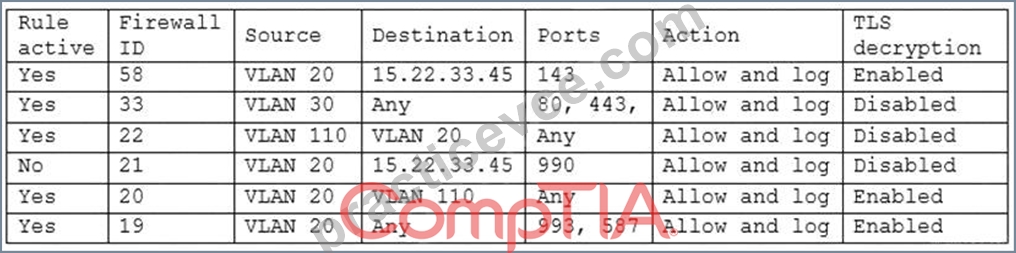
Which of the following should the security engineer do to ensure IMAPS functions properly on the corporate user network?
- A. Make sure the UTM certificate is imported on the corporate computers.
- B. Create an IMAPS firewall rule to ensure email is allowed.
- C. Confirm the email server certificate is installed on the corporate computers.
- D. Contact the email service provider and ask if the company IP is blocked.
Answer: B
NEW QUESTION # 128
A SaaS startup is maturing its DevSecOps program and wants to identify weaknesses earlier in the development process in order to reduce the average time to identify serverless application vulnerabilities and the costs associated with remediation The startup began its early security testing efforts with DAST to cover public-facing application components and recently implemented a bug bounty program Which of the following will BEST accomplish the company's objectives?
- A. CMS
- B. SAST
- C. RASP
- D. WAF
Answer: B
Explanation:
Explanation
Static application security testing (SAST) is a method of analyzing the source code of an application for vulnerabilities and weaknesses before it is deployed. SAST can help identify security issues earlier in the development process, reducing the time and cost of remediation. Dynamic application security testing (DAST) is a method of testing the functionality and behavior of an application at runtime for vulnerabilities and weaknesses. DAST can cover public-facing application components, but it cannot detect issues in the source code or in serverless applications. Runtime application self-protection (RASP) is a technology that monitors and protects an application from attacks in real time by embedding security features into the application code or runtime environment. RASP can help prevent exploitation of vulnerabilities, but it cannot identify or fix them. A web application firewall (WAF) is a device or software that filters and blocks malicious web traffic from reaching an application. A WAF can help protect an application from common attacks, but it cannot detect or fix vulnerabilities in the application code or in serverless applications. References: [CompTIA Advanced Security Practitioner (CASP+) Certification Exam Objectives], Domain 3: Enterprise Security Operations, Objective 3.4: Conduct security assessments using appropriate tools
NEW QUESTION # 129
A security analyst is researching containerization concepts for an organization. The analyst is concerned about potential resource exhaustion scenarios on the Docker host due to a single application that is overconsuming available resources.
Which of the following core Linux concepts BEST reflects the ability to limit resource allocation to containers?
- A. Device mapper
- B. Cgroups
- C. Linux namespaces
- D. Union filesystem overlay
Answer: B
Explanation:
Cgroups (control groups) is a core Linux concept that reflects the ability to limit resource allocation to containers, such as CPU, memory, disk I/O, or network bandwidth. Cgroups can help prevent resource exhaustion scenarios on the Docker host due to a single application that is overconsuming available resources, as it can enforce quotas or priorities for each container or group of containers. Union filesystem overlay is not a core Linux concept that reflects the ability to limit resource allocation to containers, but a technique that allows multiple filesystems to be mounted on the same mount point, creating a layered representation of files and directories. Linux namespaces is not a core Linux concept that reflects the ability to limit resource allocation to containers, but a feature that isolates and virtualizes system resources for each process or group of processes, creating independent instances of global resources. Device mapper is not a core Linux concept that reflects the ability to limit resource allocation to containers, but a framework that provides logical volume management, encryption, or snapshotting capabilities for block devices. Verified References:
https://www.comptia.org/blog/what-is-cgroupshttps://partners.comptia.org/docs/default-source/resources/casp-co
NEW QUESTION # 130
An organization's hunt team thinks a persistent threats exists and already has a foothold in the enterprise network.
Which of the following techniques would be BEST for the hunt team to use to entice the adversary to uncover malicious activity?
- A. Deploy a SOAR tool.
- B. Implement decoy files on adjacent hosts.
- C. Modify user password history and length requirements.
- D. Apply new isolation and segmentation schemes.
Answer: D
NEW QUESTION # 131
A security team received a regulatory notice asking for information regarding collusion and pricing from staff members who are no longer with the organization. The legal department provided the security team with a list of search terms to investigate.
This is an example of:
- A. due intelligence
- B. due care.
- C. legal hold.
- D. e-discovery.
Answer: A
Explanation:
Reference: https://www.ansarada.com/due-diligence/hr
NEW QUESTION # 132
An organization must implement controls that are aligned with its financial requirements; specifically, the organization is looking to implement the following:
- Financial transactions that require one reviewer
- Audits of funds disbursements
- Cross-training of employees
Which of the following controls will address the organization's requirements?
- A. Change management
- B. Least privilege
- C. Separation of duties
- D. Job rotation
Answer: C
NEW QUESTION # 133
A security architect is designing a solution for a new customer who requires significant security capabilities in its environment. The customer has provided the architect with the following set of requirements:
* Capable of early detection of advanced persistent threats.
* Must be transparent to users and cause no performance degradation.
+ Allow integration with production and development networks seamlessly.
+ Enable the security team to hunt and investigate live exploitation techniques.
Which of the following technologies BEST meets the customer's requirements for security capabilities? A.
- A. Centralized logging
- B. Sandbox detonation
- C. Threat Intelligence
- D. Deception software
Answer: D
Explanation:
Deception software is a technology that creates realistic but fake assets (such as servers, applications, data, etc.) that mimic the real environment and lure attackers into interacting with them. By doing so, deception software can help detect advanced persistent threats (APTs) that may otherwise evade traditional security tools
12. Deception software can also provide valuable insights into the attacker's tactics, techniques, and procedures (TTPs) by capturing their actions and behaviors on the decoys Deception software can meet the customer's requirements for security capabilities because:
It is capable of early detection of APTs by creating attractive targets for them and alerting security teams when they are engaged12.
It is transparent to users and causes no performance degradation because it does not interfere with legitimate traffic or resources13.
It allows integration with production and development networks seamlessly because it can create decoys that match the network topology and configuration It enables the security team to hunt and investigate live exploitation techniques because it can record and analyze the attacker's activities on the decoys13.
NEW QUESTION # 134
......
Verified CAS-004 dumps Q&As - 2025 Latest CAS-004 Download: https://vce4exams.practicevce.com/CompTIA/CAS-004-practice-exam-dumps.html